
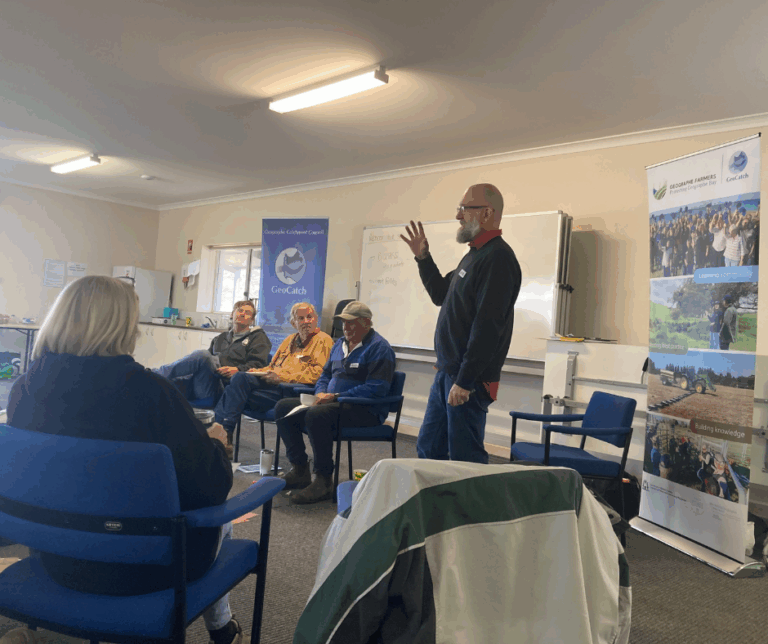
David Hardwick facilitating GeoCatch’s workshop to help attendees understand complex soil food web interactions.
Explaining how to build soil carbon, while at the same time promoting soil biology that breathes (or respires) carbon back into the atmosphere, is not a simple task.
However, it was made simple by consultant David Hardwick from Soil Land Food who presented at the recent GeoCatch event Reboot Your Soils.
David is an incredibly engaging presenter who employs fun activities like soil judging and role-playing.
But within this simple role-playing was the more complex theme of cycling nutrients found in soil organic matter and the consequences for soil carbon.
What is Soil Organic Matter
Soil organic matter (SOM) is any living or dead plant or animal material in the soil.
It is composed of soil organic carbon, nitrogen, phosphorus and typically all the other essential plant nutrients.
SOM comes in different forms, with some more easily and quickly decomposed than others.
David explained how SOM is decomposed by fungi and bacteria that are then eaten by bigger organisms such as protozoa and nematodes, which are in turn eaten by mites and springtails for example.
These interactions along the food chain results in nutrients like nitrogen being released into plant available forms.
But what happens to the carbon?
For easily decomposed forms of SOM (e.g. particulate organic matter), most of the carbon is respired back into the atmosphere as carbon dioxide, primarily by bacteria.
However, some of the carbon is sequestered into microbial cells or converted into more complex organic molecules that make humus, a form of organic matter that is more resistant to degradation and therefore persists in the soil for longer.
Humus has many beneficial traits including water holding capacity, cation exchange capacity and moderating changes in soil pH.
Let’s consider soil respiration
A key factor affecting the decomposition of SOM is the rate of soil respiration, which could indicate that the microbial community is very active, stressed, or the size of the microbial community is large.
High respiration
A very high level of respiration, particularly caused by excessive bacterial activity is not necessarily desirable because it may mean we are losing soil organic matter faster than we can replace it with crop residues and the like.
Some key factors that increase respiration are high soil temperature (when moist), soil disturbance, soil acidity (<5.5 in CaCl2) and an excess of soluble nutrients.
Low respiration
On the other hand, if microbial activity and soil respiration is low, which can occur in waterlogged or highly acidic soils (e.g. <4.5 in CacCl2), nutrient cycling may be reduced, inhibiting plant growth and potentially resulting in a build-up of SOM.
Getting the balance right
So, to build soil carbon, we could try to limit losses by reducing soil disturbance and excessive nutrient application and maintaining soil pH above 5.5. Limiting soil erosion by maintaining groundcover can also reduce losses.
On the other side of the coin to losses from respiration and erosion are gains from organic inputs such as from crop or pasture roots, above-ground biomass and manure.
Low rates of organic inputs make it harder to keep up with losses. So, we need to grow and allocate biomass back into the soil rather than exporting it all as produce.
This means promoting pasture and root growth by addressing constraints to growth, not grazing too hard too often and perhaps leaving more stubble behind.
In conclusion…
Building soil carbon is ultimately a balancing act between the natural losses that occur through microbial respiration, and the gains microorganisms make by returning organic material to the soil. By managing factors like pH, soil disturbance, nutrient inputs, and groundcover, we can minimise unnecessary losses, while boosting plant growth. Healthier soils come from working with biology, nurturing the living systems beneath our feet so they can sequester carbon, grow more crops, and sustain environmental conditions for the long term.
For more articles and resources on building soil health, visit the Soil Health section of our Sustainable Agriculture Library below.