
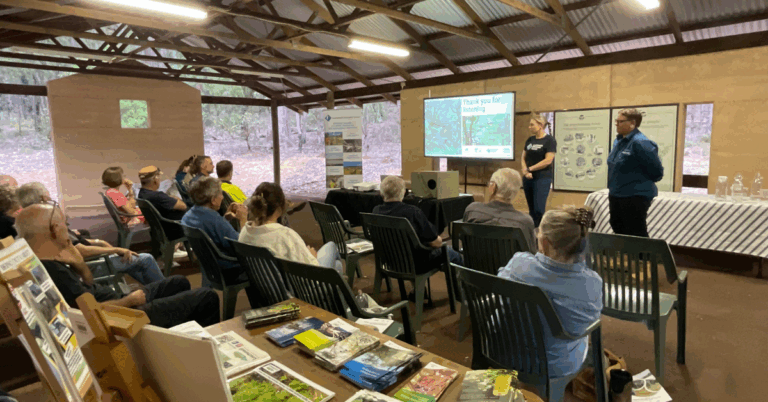
(Front) Jess Forsyth from Leschenault Catchment Council and Kate Duzevich
from Leschenault Biosecurity Group speak with participating landholders.
Landholders living on boundaries of the Wellington National Park are reporting seeing native wildlife species on their properties they haven’t spotted in years following completion of an 18-month project targeting reduction of introduced predators by South West NRM and Leschenault Catchment Council.
The two environmental organisations received a Saving Native Species grant from the Australian Government in May, 2024 to protect native species living in Wellington National Park and under threat of extinction.
Under the Saving Native Species in Wellington National Park project, they teamed up with Leschenault Biosecurity Group (LBG) who coordinated and delivered the targeted and highly successful on-ground feral animal control program to support park populations of the chuditch (western quoll), quokka and western ringtail possum.
South West NRM Acting CEO Linda Metz said one of the biggest threats to their ongoing survival was populations of introduced predators such as foxes, feral cats and feral pigs which preyed on wildlife and/or destroyed their habitats.
“While introduced predator control within the National Park is undertaken by the Department of Biodiversity, Conservation and Attractions (DBCA) through the Western Shield Program, beyond the park boundaries where privately-owned properties are located, the threat of these predators often remains,” Ms Metz said.
“It was the owners of these private properties which we sought to work with through this project, targeting introduced predators roaming on their land that were beyond the reach of Western Shield but likely to still be entering the National Park to prey on native wildlife.”
A total of 61 landowners in the Preston Valley put their hands up to be involved, well beyond initial hopes and expectations for the project.
And as a result of control works undertaken, 316 introduced predators were removed.
What Participating Landowners had to say
Participating landowner Charmaine Ferriera said: “Being part of this project has made a real difference – not just to our land but to the native species living around it. We’ve seen the return of wildlife that we hadn’t spotted in years such as quendas, possums, skinks and an array of birds.”
Property owner Scott Bartholomew said: “This project was a welcome relief to not only monitor what was captured on camera but to back it up with control mechanisms to reverse the trend of biodiversity loss.”
Participating landholders along with representatives from all three environmental organisations involved in the project, gathered at the Wellington Discovery Forest Centre last week to celebrate project achievements and share learnings.
Check out the Landholder Information Booklet
A printed landholder booklet designed to facilitate ongoing action to reduce the impact of introduced predators on threatened species was also circulated. The publication is now available as a digital resource for other land owners who might be interested in undertaking feral animal control on their property.
In phase one of the Saving Native Species in Wellington National Park Project, fauna monitoring cameras were installed on 21 properties to collect data on the type and number of feral cats, feral pigs and foxes in the area to inform future stages of the project.
As well as pest animals, the remote cameras also provided an entertaining collection of wildlife snaps from the elusive chuditch, to brushtail possums, echidnas, emus and kangaroos.
Under the project, landholders were provided with training on effective pest animal control measures by LBG and supported through a series of special events.
As a result, across all participating properties, 143 foxes, 8 cats and 165 pigs were removed and prevented from diminishing precious numbers of native species living in Wellington National Park.
This project received grant funding from the Australian Government Saving Native Species Program.