
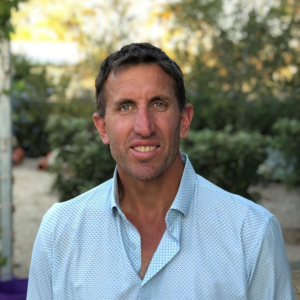
Wayne Pech
The GRDC podcast recently spoke to Wayne Pech about his and his wife Jody’s mixed grain and sheep farm in WA’s Great Southern, and the long-term thinking guiding their decisions beyond the next season.
Like all growers, decisions are influenced by variability, uncertainty, and the constant need to adapt. Where Wayne’s perspective stands out is in how deliberately he has reshaped his business to deal with that uncertainty.
In case you prefer to read rather than listen, we gathered up a podcast summary of the salient points.
Making space to think
A central theme of Wayne’s approach is management structure. Over time, he has moved away from trying to do everything himself, instead building a team of around eight staff, including a farm manager, permanent operators, stock-focused staff and casual workers. Jody plays a critical role in administration and finance, while their daughters are beginning to show interest in agriculture in different ways.
For Wayne, stepping back from the day-to-day isn’t about disengaging it’s about creating the mental space to think ahead.
“If you’re hands-on all day every day, you don’t give yourself time think about the bigger picture,” he says. Delegating operational responsibility has allowed him to focus on strategic questions: land use, climate risk, staffing, and where the business needs to be in five, ten or fifteen years.
Climate risk as a business issue
Wayne doesn’t frame climate change as an abstract debate. For him, it’s a practical risk to manage much like market volatility or input costs.
He began engaging seriously with emissions and climate impacts after concluding that increasing climate variability posed a real threat to agricultural communities. While agriculture is not the largest emitting sector, Wayne argues that farmers still need to understand their position and be prepared for more frequent extreme events.
That thinking has driven several changes in the business.
One of the first was land use. Historically, the farm ran closer to a 50:50 split between cropping and sheep. Over time, that balance has shifted to around 65% cropping. Hotter, drier summers were making it harder to maintain sheep condition, so increasing cropping created more stubble feed and reduced pressure on pasture.
The outcome was unexpected but positive: even with fewer sheep and less livestock area, improved condition and management meant lamb production remained strong. In effect, the business is producing similar outputs from a smaller footprint and with a lower risk.
Measuring what matters
Wayne is also candid about the role of measurement. Engaging with carbon calculators has reshaped how he thinks about emissions, particularly in cropping systems.
One key learning was around emissions intensity. Rather than minimising inputs and yield, the data showed that maximising yield and water-use efficiency can reduce emissions per tonne of grain produced. Higher yields, better profitability and lower emissions intensity can align.
For livestock, the principle is similar. Turning sheep off sooner reduces lifetime emissions per animal, while also improving enterprise efficiency. Again, these decisions are framed as good business first, with emissions outcomes as a by-product.
Trying new things with caution
Wayne is a member of AgZero2030, a WA-based group encouraging practical conversations around climate change, emissions, renewables and agriculture’s role in the broader energy transition. He acknowledges that being vocal early came with backlash, but says the goal has always been awareness, not argument. Within his own business, experimentation has been cautious and scaled, and agroforestry is one example of that. Currently, trees occupy around 400 hectares (less than 5 percent) of the 13,000-hectare operation. While there is potential to expand, Wayne is clear-eyed about the commitment involved. “You can change a crop every year. Trees lock land up for decades,” he notes. Decisions are made slowly, with staff buy-in and long-term implications front of mind.
The same thinking applies to staffing and changes in management. Wayne has learned that even well-intentioned innovations fail without team support. Major changes are discussed, not imposed.
Looking to 2040
When Wayne looks ahead to 2040, his vision is evolutionary rather than revolutionary.
He expects cropping to remain around current levels, livestock to occupy a smaller but more efficient portion of the business, and trees to play a greater role on marginal land. Electrification looms large: solar, batteries, microgrids, and electric vehicles are all part of how he imagines reducing reliance on poles and wires, improving resilience during storms or fires, and lowering operating costs.
Many farm vehicles, he notes, travel less than 50 kilometres a day making them well-suited to electrification. Even electric grain trucks, with battery swapping for shorter hauls, are already technically feasible.
Why it matters
What keeps Wayne motivated isn’t just technology or systems, it’s people. The growing interest of his daughters in agriculture has given new meaning to long-term planning. Farming, he says, is easier to persist with when there’s a future to hand over.
His story is not about having all the answers. It’s about asking better questions: how to reduce risk, how to stay profitable, and how to adapt without losing sight of what matters.
In an industry facing increasing variability, Wayne’s experience suggests that resilience doesn’t come from one big solution but from many deliberate, well-considered steps taken over time.
You can listen to the full conversation here: GRDC in Conversation: Wayne Pech – GRDC