
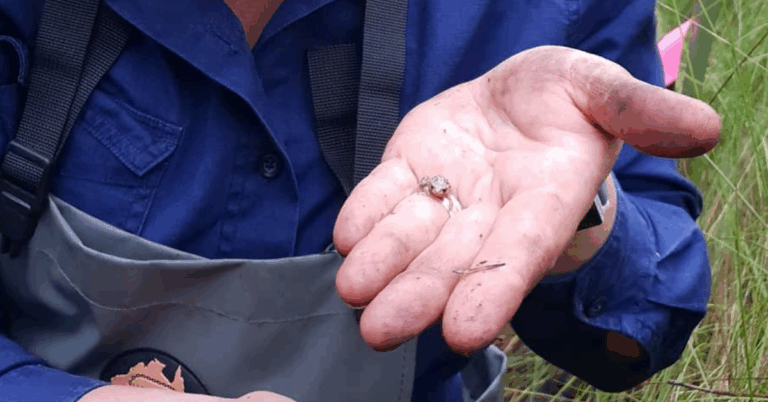
Picture Courtesy Christine Taylor, Department of Biodiversity, Conservation and Attractions.
Four frog species have slipped silently into extinction in Australia.
Another 26 are clinging by their little frog fingers to existence – identified as those MOST at risk of tumbling off the cliff edge into non-existence.
Just one of the 26 lives in Western Australia, in our South West of WA near Margaret River.
Scientists believe the tiny white-bellied frog had been quietly existing in forest creeks for about 15 million years before its distinct call landed in the ears of a couple of frog experts.
First discovery
It was 1983 and Grant Wardell-Johnson and Dale Roberts (both now with highly distinguished academic careers) were camping under the stars after a day of ‘frogging’ or surveying.
With hearing highly attuned to the sound of local frog calls, they immediately realised they had stumbled upon something new. How surprised they must have been to discover the diminutive size of the creature behind such a large voice – a distinctly-different little frog only as big as their thumbnail.
What quickly became clear as they investigated more, was that this tiny little frog was sitting perilously close to the edge of extinction.
Action underway
By 1995 it was listed as Endangered and a Recovery Plan was published outlining various conservation actions designed to provide the white-bellied frog with a leg-up.
Importantly, annual monitoring occurred to better understand population patterns and trends while assessing the effectiveness of management actions.
Instead of recording individual frogs, sub-populations or individual little frog families are identified with somewhere between 2 and about 20 calling males in each.
The highest number of sub-populations ever recorded was 117 but sadly since then, more than half have gone extinct – confirmed by the deafening silence where distinctive calls were once heard. All of those who remain (including some new sub-populations established through translocation) are located within a very limited area estimated to be less than 2km2.
30 years later and after a revised Recovery Plan in 2015, the intensive efforts of a Recovery Team involving staff from WA’s Department of Biodiversity, Conservation and Attractions (DBCA), university researchers, a Perth Zoo head-starting program and at certain points South West NRM (then South West Catchments Council), the white-bellied frog remains in peril, largely due to changing land uses and our changing climate.
In 2019 the species was upgraded from ‘Endangered’ to the newly created category of ‘Critically Endangered’ under the Environment Protection and Biodiversity Conservation Act 1999.
The climate change threat
Their fragility in the face of declining rainfall and warming temperatures was all too clear when scientists and their listening equipment sat out in the forests during the nights of spring, 2024 recorded a sudden drop in the number of calling males.
It followed a recognised period of drought in the area across the spring/summer of 2023/24.
The following year was kinder though, with more rainfall and a resulting small recovery of numbers recorded in spring, 2025.
A new project to help
With funding from the Australian Government, South West NRM has again partnered with DBCA in support of recovery actions across a five-year period designed to secure the white-bellied frog’s future once and for all.
As well as supporting the ongoing collection of data on existing populations, work is happening to identify new sites which meet the very specific set of criteria and characteristics needed for white-bellied frogs to thrive.
Once identified, new Rice Bubble-sized frog babies from the Perth Zoo’s native species breeding program may be translocated to the sites in the hope that new populations will establish.
And that’s not all.
You might have heard about the other current project we’ve been working on with DBCA, also designed to save the white-bellied frog. Read more here.
Stay tuned for further updates.