
For the past three to four years, DPIRD researcher Brittany Bolt and her team have collected individual feed intake and methane production data on over 1200 lambs sired by terminal, maternal, Dorper and Merino breeds.
The research at Katanning is working towards establishing feed intake and methane breeding values. The goal of this project is to produce information that can be shared with industry through channels such as the Australian Sheep Breeding Values (ASBVs) allowing producers to select for feed efficiency in the same way they would select for growth or carcase traits.
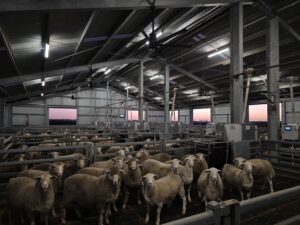
Katanning Research Facility
Brittany spoke about the research at South West NRM’s recent Sheep Productivity event in Manjimup saying, “Early findings are encouraging. The key takeaway is that there is genetic variation in both feed intake and methane production within every breed type”.
With low-intake, low methane emitting animals identified across breeds, the focus is on identifying individual animals that have these traits. These animals not only have lower methane emissions and feed requirements, but they perform as well in weight gain as the higher intake, higher emissions animals.
For producers the good news is that focusing on productivity within your sheep enterprises – e.g. culling dry ewes, increased lambs weaned, increased growth rates, quicker turnoff, and higher fleece weights – you have also been reducing methane intensity.
More productive sheep = less methane per unit of output
Brittany confirmed that the development of feed intake and methane breeding values will be ongoing saying that “We’re not there yet, but the MLA Resource Flock data is what makes it possible, with access to a wide range in genetics from industry nominated sires used across Australia”.
For more information, please visit DPIRD Sheep Genetic Resource Flock or contact Brittany Bolt at [email protected]
South West NRM’s FEaST2030 project is supported by the Australian Government through funding from the Natural Heritage Trust under the Climate-Smart Agriculture Program.