
July 2026
A bold habitat rehydration trial, designed to save one of Australia’s tiniest and most endangered frogs from the impacts of a drying climate, will continue through the coming months.
This will enable refinement and testing of the rehydration technique to be applied during the current El Niño weather event, which is expected to bring hotter and drier than average conditions across 2026/27.
South West NRM’s white-bellied frog project, being delivered in partnership with the Department of Biodiversity, Conservation and Attractions (DBCA), has received funding of $85,028 from the Australian Government’s Saving Native Species Program.
The pilot project is using a complex and high-tech system involving sprinklers, high sensitivity soil moisture sensors and remote monitoring to test whether rehydrating drying breeding habitat near Margaret River could help boost diminishing populations of the white-bellied frog.
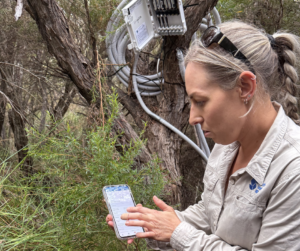
Jess Forsyth, South West NRM Project Officer Environment, testing high-tech equipment at the white-bellied frog rehydration site.
Refinements were made and more data was collected on soil moisture and temperature across three project sites – one receiving irrigation at a pre-determined trigger point and two not irrigated, for comparison.
Resulting data from the trial to-date, showed that with irrigation, ideal soil moisture conditions for white-bellied frogs could be maintained during the highest-risk dry periods in late Summer and Autumn.
South West NRM CEO Dr Manda Page said the Niño weather event presented an opportunity to further test the innovative approach during more extreme weather conditions, hopefully fortifying confidence in its future application elsewhere.
“To understand just how fragile this species is to declining rainfall and warming temperatures, we only have to go back to the spring of 2024 which followed a recognised period of drought in South West, WA,” Dr Page said.
“That spring coincided with DBCA scientists recording a drop in the number of calling males compared to previous years – a foreboding indicator of outcomes for the next breeding season and frog numbers generally.”
But results of the rehydration trial so far combined with the opportunity to continue trial research has buoyed spirits and, according to Dr Page, improved the opportunity of converting science into action.
“If we can prove that this rehydration technique has been successful, we pave the way for future translocations, potentially using frogs from the Perth Zoo’s headstarting program to re-establish populations and hopefully contribute to securing a more long-term future for the species,” Dr Page said.
The white-bellied frog is one of 110 priority threatened species identified in the Australian Government’s Threatened Species Action Plan 2022-32.
Adults grow to about the size of a human thumbnail while their babies are no bigger than a Rice Bubble.
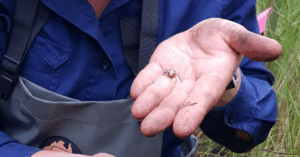
Picture Courtesy Christine Taylor, Department of Biodiversity, Conservation and Attractions.
But their future is in peril since more than half of the known subpopulations have gone extinct over the past two decades with the drying climate being a major contributing factor.
As well as the Australian Government and DBCA, Dr Page thanked the Water Corporation (South West region) plus the range of other contractors and community supporters who had helped so far in delivering a complex but promising project.
Find more information about the white-bellied frog rehabilitation project funded by the Australian Government’s Saving Native Species Program here.