
When you’re trialing ways to keep habitat moist for one of Australia’s most critically endangered frogs, having access to a reliable source of suitable water is essential.
But securing that water has proved to be one of the more complex practical challenges for South West NRM’s white-bellied frog rehydration trial in the Margaret River region.
The project is trialing habitat rehydration techniques to help maintain moisture levels through critical dry conditions, with monitoring helping to build an understanding of how these interventions may support habitat conditions for the white-bellied frog into the future.
The project recently received an extension of funding from the Australian Government’s Saving Native Species Program, allowing the trial to continue for another 12 months. With an El Niño underway, the additional time provides an important opportunity for further monitoring and scientific data collection through potentially challenging conditions.
The challenge of securing suitable water
Water stored in the rehydration trial site’s tank is now getting low. And while that might seem surprising at the end of winter, unlike a household rainwater tank, the tank at the remote trial site does not have a large roof catchment feeding it. The trial’s initial water supply was provided by Water Corporation South West, but water for the rehydration system now needs to be sourced elsewhere and transported to the site.
Finding a suitable source is not simply a matter of finding available water. The project team is looking for water with chemistry that is a suitable match to the background water chemistry of the white-bellied frog’s habitat.
Recently, Karri Karrak Aboriginal Corporation Rangers collected water samples from a large dam on private property, measuring temperature and pH at the time of sampling as both can change during transportation and can significantly influence water chemistry.
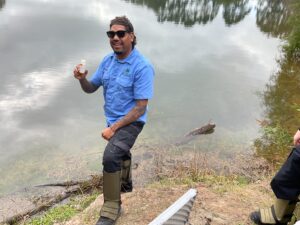
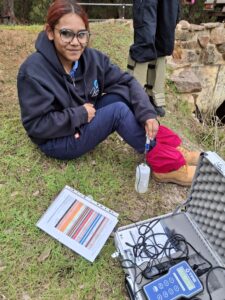
Karri Karrak Aboriginal Corporation Senior Ranger Chris Franklin and Ranger Margaret Ugle collecting and testing water samples at a nearby private property.
The samples will undergo further laboratory testing in Perth across a range of water-quality parameters. These include pH, to ensure the water is not too acidic or alkaline, as well as alkalinity (the ability of water to buffer changes in pH), phosphate, dissolved inorganic nitrogen and fluoride. The results will then be compared with known background levels and accepted toxicant levels for freshwater to help determine whether the water is suitable for use at the trial site.
Water quality is particularly important for frogs because of their highly permeable skin, which makes them sensitive to water chemistry. Poor water quality can affect their health, development and survival.
If the water is found to be a suitable match, the project team will hold further discussions with the landholder or property manager about accessing and using the water at the project site.
Getting water to the trial site has also involved considerable collaboration. If a suitable new water source is secured, the project team hopes to again work with the Karridale and Witchcliffe Volunteer Bushfire Brigades to transport the water to the trial site.
Monitoring conditions at the trial site
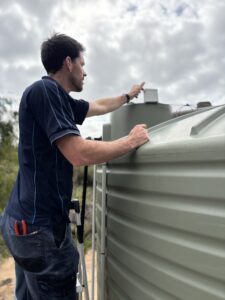
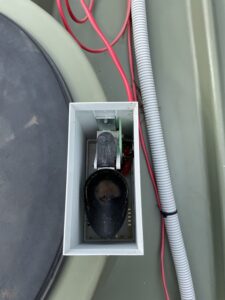
Mike from Think Water, Capes Region repairs a rain gauge at the rehydration site.
Monitoring at the trial site is also continuing, with Think Water undertaking maintenance of a rain gauge to provide site-specific rainfall data.
Rather than relying on rainfall recorded at nearby Bureau of Meteorology weather stations, the rain gauge will allow the project team to compare rainfall events at the site with changes in soil moisture, helping to build a better understanding of the site’s water needs.
Continuing the trial through El Niño
Continuation of the trial comes as the South West faces another potentially challenging season. In June, the Bureau of Meteorology confirmed an El Niño event, with forecasts indicating an increased likelihood of below-average rainfall across parts of southern Australia in the months ahead.
El Niño events are often associated with drier-than-average conditions and above-average temperatures in Australia, particularly during winter and spring. While no two El Niño events are the same, the outlook comes against the backdrop of the South West’s longer-term drying trend and the increasing pressure changing rainfall patterns and rising temperatures are placing on threatened species and their habitat.
Continuing the rehydration trial through these conditions will provide an opportunity to further investigate whether targeted rehydration can help maintain critical habitat moisture during dry periods.
The project is being delivered in partnership with the Department of Biodiversity, Conservation and Attractions (DBCA) and funding from the Australian Government’s Saving Native Species Program.
Learn more about the white-bellied frog rehydration project:
https://southwestnrm.org.au/projects/saving-native-species-white-bellied-frog/