
From frost-affected canola to cold-tolerant chickpeas, there’s plenty happening in agricultural research across WA!
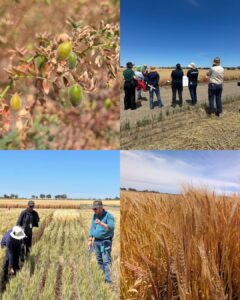
In October 2026, South West NRM headed out to DPIRD’s Dale Research Field Day near York, where researchers, agronomists and growers came together to explore some of the latest developments in broadacre cropping.
The day showcased research into canola frost sensitivity, root lesion nematode management, chickpea chilling tolerance and milling oat agronomy, with early findings offering some interesting insights into crop resilience, variety selection and production efficiency.
We’ve pulled together a few highlights from the day and what the research is uncovering.
Reducing Frost Sensitivity of Canola
DPIRD Research Scientist Dr Brenton Leske presented findings from the Grains Research and Development Corporation (GRDC) funded Reducing the Frost Sensitivity of Canola in Australia project (DAW2510-002RTX). The Dale trials assessed approximately 300 canola lines, examining differences in flowering, branching, pod development and frost recovery.
What is the research showing?
Early observations highlight canola’s ability to compensate for frost damage through continued flowering and the development of secondary branches and pods as conditions improve. This suggests growers should be cautious about writing off frost-affected spring canola too early.
Winter canola lines largely avoided frost damage but struggled to complete flowering before the dry spring finish, highlighting the importance of matching flowering requirements to local growing conditions.
What's next?
Initial analysis is expected in February 2027, with full results anticipated in March. The findings will help identify genetic traits that could be incorporated into future canola breeding programs to reduce frost sensitivity.
Find out more: GRDC – Research and Investments
Nematode Management and Cereal Variety Performance
DPIRD Research Scientist Carla Wilkinson presented research investigating cereal variety resistance to the root lesion nematode Pratylenchus quasitereoides, a soilborne pest found in approximately 30% of WA paddocks, particularly in cooler south-western growing regions.
The trials assess how nematode populations change under different cereal varieties, with soil samples collected after seeding and at the end of the growing season.
What is the research showing?
Serradella and lupins have shown greater resistance, while barley, canola and oats are among the least resistant crops. Highly susceptible varieties, including Maximus CL barley and Calingiri wheat, can encourage rapid nematode population growth.
DPIRD research has not identified varietal tolerance in wheat or barley, meaning crop selection and rotations remain important tools for managing nematode populations.
What should growers look for?
Damage can appear as uneven growth, reduced tillering, yellowing of lower leaves and early wilting under moisture stress, often occurring in patches.
Pre-season PREDICTA B soil testing can help identify nematode populations, while in-season plant samples can be submitted to DPIRD’s Diagnostic and Laboratory Services (DDLS) for investigation.
Find out more: SARDI – PREDICTA B
Milling Oat Agronomy
DPIRD Cereal Scientist Dr Blakely Paynter, alongside ConsultAg’s Trent Butcher and Garren Knell, presented research investigating how sowing time, plant density and nitrogen management influence the yield, quality and profitability of milling oats.
The trials, supported by the GRDC and the Processed Oat Partnership (POP), are examining variety-specific agronomic strategies, particularly for newer milling varieties such as Goldie and Minnie.
What is the research showing?
Early findings indicate that Goldie and Minnie respond differently to nitrogen compared with established varieties such as Bannister. Both appear to offer greater flexibility in nitrogen management, although higher nitrogen rates can increase the risk of lodging and stem breakage, particularly in Goldie.
Researchers are also investigating whether Minnie can be sown at hay production densities of approximately 320 plants/m² while still achieving OAT1 milling grade, potentially offering growers greater flexibility between hay and grain production.
The research highlights the importance of developing variety-specific management strategies rather than relying on historical recommendations developed for Bannister and Williams oats.
What's next?
Further analysis will help refine recommendations for sowing time, plant density and nitrogen application, with a focus on balancing grain yield, milling quality and profitability.
Find out more: GIWA – Processed Oat Partnership
Want to learn more? For free, in-person advice and valuable contacts, get in touch with Sustainable Agriculture Facilitator Amelia Thornton by emailing [email protected] or phone 0427 806 193.
The Sustainable Agriculture Facilitator role is part of a national network supported by the Australian Government through funding from the Natural Heritage Trust under the Climate-Smart Agriculture Program.