
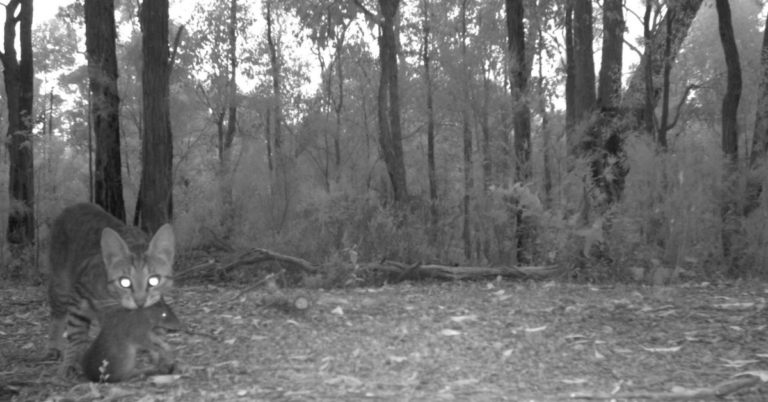
According to research, a feral cat roaming through the bush will kill about two animals every day.
That rings true as a DBCA project team sifts through data from 149 camera traps deployed late last year in the majestic jarrah forests of our South West region in WA.

There’s grim photos of the same feral cat six nights in a row with a kill in its mouth.
Now let’s think about the impact of that single feral cat captured in the act, multiplied by 720,000 times – the estimated number of feral cats on the loose in WA right now. That’s a lot of dead animals.
The impact of feral cats on native wildlife
Within our state there are at least 69 native species vulnerable to predation by feral cats. Some of them have been reduced to tiny populations – perched on the cliff-edge of extinction. As a result, they are nationally listed as critically endangered.
Across Australia, predation by cats has been identified as a significant factor in 27 of the 47 extinctions of Australian reptiles, birds and mammals.
If we are to save iconic species like the endangered numbat (Myrmecobius fasciatus), which has less than 3,000 individuals left in the wild, we must manage the significant feral cat threat.
I’ve spent 30 years working in environmental conservation and like many in the sector, was initially drawn to it by a love of animals and nature. Unfortunately, I have seen first-hand the impact of feral cats on our wildlife and am convinced we need to continually work on improving methods of effective control.
Ultimately, that means identifying how we remove the feral cat threat humanely and without risk to populations of non-target species.
Controlling feral cats with artificial intelligence
Solid success was achieved on this front by a South West NRM trial between 2020 and 2023 which aimed to test the effectiveness of new technology for reducing feral cats.
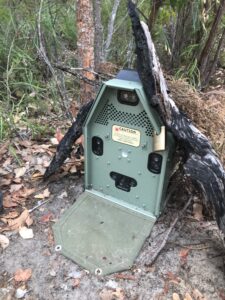
Called the FelixerTM , my team was excited by the opportunity to test out this cutting-edge new tech in partnership with DBCA and Blackwood Basin Group.
At the time, the Felixer™ grooming traps used innovative sensors and recognition software, tested for WA conditions by DBCA using the trap’s non-toxic, photo-only mode on captive numbat populations at Perth Zoo, to ensure it could distinguish cats and foxes from non-target wildlife.
Once deployed out in the field in toxic mode, the Felixer™ unit senses a target predator species and a gel shot containing 1080 toxin is fired onto its fur which is later ingested through grooming behaviour.
Up to eight Felixer™ traps were set up during the trial at four sites within the ecologically diverse Upper Warren and Lake Muir areas.
The trial results showed a reduction in cat activity of up to 49% across the four trial sites which was sustained over a 15-week period. That was excellent news not just for the Felixer™ trial but for native wildlife living in that area too. You can read more about the project and the final report here.
What we’re doing now to control feral cats
Since that initial trial, the Felixer™ has been upgraded with AI to improve target recognition ability, so following on from those early promising results, we’ve been supporting further testing of the Felixer™ by DBCA in our South West.
In this latest and current trial which ran for just over 12 months across 2025 and 2026, the number of Felixer™ units was increased and they were strategically positioned in South West forests using the learnings from the first trial, with remote cameras also being deployed to help track feral cat activity.
The good news is that feral cat activity was reduced in South West forests where trials were carried out.
But for DBCA scientists, who are continuing to distil an earth-shattering amount of data from this Stage 2 trial – that is far from the whole picture.
Questions remain around how the Felixer™ can most effectively and efficiently complement existing landscape-scale methods used to control feral cats to boost the resilience of our most at-risk native wildlife.
Things to consider include the potential, that at a local scale, removing resident feral cats can mean neighbouring cats or foxes move in OR the activity levels of remaining feral cats may increase.
It’s complex!
For greater clarity, DBCA scientists are analysing the data in even more detail – right down to the level of being able to identify the movements and behaviours of individual cats.
We’ll be sure to keep you posted on the outcomes of this work.
In the meantime, there’s plenty we can all do to help reduce the threats on native wildlife.
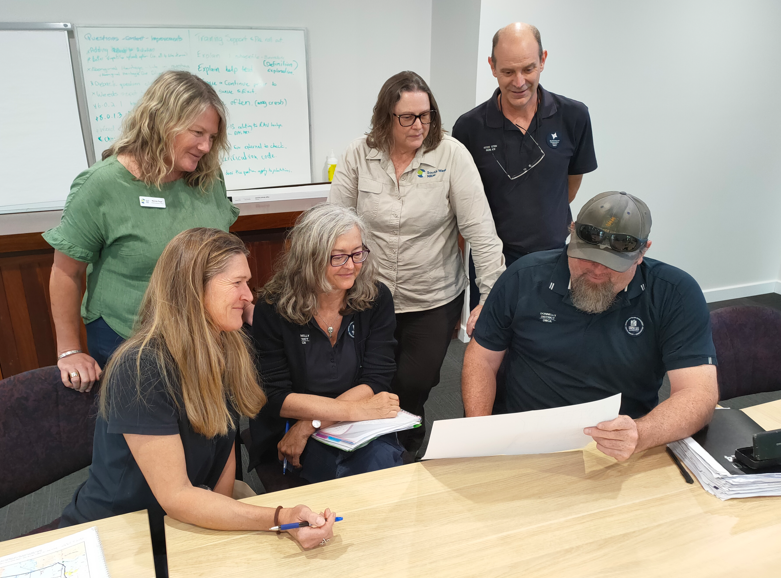
Photo Caption: SWNRM staff in a planning meeting with DBCA Research Scientists and District Conservation Staff discussing the second and current phase of work to control feral cats in South West forests using the Felixer™ grooming trap.
From left, SWNRM CEO Dr Manda Page, DBCA Technical Officer Marika Maxwell, DBCA District Conservation Officer Jenny Carley, former SWNRM Program Manager Environment Robyn Nicholas, DBCA Principal Research Scientist Dr Adrian Wayne and DBCA District Conservation Coordinator Mark Virgo.
What you can do to help
- Keep your pets indoors. Evidence shows that unfortunately, wandering pet cats will also hunt outside the home and contribute to the impact of feral cats on populations of native animals. Keeping cats indoors or outside but within a catio structure will protect both them and local native species. You can find lots of resources on this page of our website.
- Add your support to the introduction of proposed new laws by the WA State Government that will empower local governments to make and enforce local laws regarding containment of pet cats. Submissions are open until August under a Statutory Review of the WA Cat Act 2011.
- Create safe havens for threatened species in your garden by planting native plants and trees. Visit the resources hub on our Western Ringtail Possum information hub for ideas.
- Share this article. Control of feral animals can be a controversial topic. This can be exacerbated by misunderstanding and misinformation. Scientific studies provide the evidence base that managers need to deliver effective conservation. Please consider sharing this article within your networks.
If you would like to receive monthly Good News updates on work South West NRM is doing every week to address the biggest environmental challenges of our time – like addressing the risk to wildlife of feral cats – please consider subscribing to our E-Newsletter here.
*South West NRM is able to support this project thanks to a generous donation received from delegates of the 2023 International Translocation Conference.
Check out more blog articles from Dr Manda Page below.