
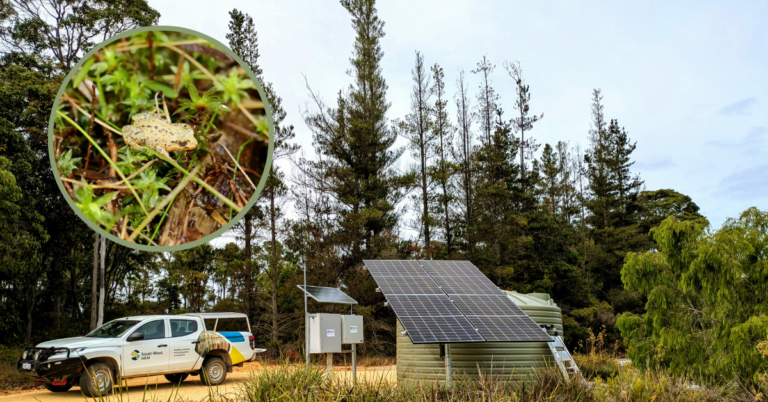
A bold and desperate plan to save one of Australia’s tiniest and most endangered amphibians has been thrown a funding lifeline by the Australian Government.
South West NRM’s white-bellied frog project, being delivered in partnership with the Department of Biodiversity, Conservation and Attractions (DBCA), has received a funding top-up of $57,750 from the Australian Government Saving Native Species Program enabling an extension of the original project parameters.
In December, the project partners completed delivery of a complex and high-tech system involving sprinklers, soil moisture sensors and satellite monitoring designed to test whether rehydrating drying creekbeds near Margaret River could help boost the diminishing frog population.
More time needed
But realising more time was needed to properly understand whether the rehydration technique was benefiting the frogs through more monitoring and scientific data collection, South West NRM sought community support prior to Christmas via a crowdfunding campaign.
Generous community members donated almost $5,000 which helped ensure monitoring of the project site could continue for a few more weeks across the critical hot summer period.
However, achieving a successful project outcome and delaying imminent decommissioning of project infrastructure including a 23,000L water tank, solar-powered pump, irrigation controller and an intricate maze of delicately installed reticulation pipe and sprinklers, would need several more months of operation.
Creating a plan
In January, South West NRM CEO Dr Manda Page worked with the Department of Climate Change, Energy, the Environment and Water which provided the first phase of project funding via its Saving Native Species grants, to build a case for extending the project.
“I’m absolutely thrilled the Australian Government has chosen to continue to support this important project,” Dr Page said.
“The white-bellied frog is one of 110 priority threatened species identified in the Australian Government’s Threatened Species Action Plan 2022-32.
“Adults grow to about the size of a human thumbnail while their babies are no bigger than a Rice Bubble.
“But their future is in peril since more than half of the known subpopulations have gone extinct over the past two decades with the drying climate being a major contributing factor.
“If we can prove that our rehydration technique has been successful, we pave the way for future translocation using frogs from the Perth Zoo’s headstarting program to help supplement numbers and hopefully contribute to securing a more longterm future for the species.”
What comes next
Dr Page said the project extension would also fire the conversion of science into action.
Included in project outcomes will be an exploration of further sites for implementation, laying out the foundations for more future projects to benefit the white-bellied frog.
Comments from the Minister
Federal Minister for the Environment and Water Murray Watt said: “This is a major step forward in protecting one of Australia’s tiniest and most endangered amphibians.
“Historic clearing has reduced the population of White-bellied frogs, and because of their size, they’re vulnerable to large, intense events, like severe fires or extreme weather.
“The Albanese Government is proud to support the hard work of South West NRM through our Saving Native Species Program, it was also great to see the community getting on board with their support of the summer campaign. We’re looking forward to seeing the outcomes of this important project.”
For more information visit our dedicated project page via the link below.