Living Firebreaks: Balancing bushfire risk and biodiversity through nature-based solutions
Home » Living Firebreaks: Balancing bushfire risk and biodiversity through nature-based solutions
About the project
As part of NRM Regions Australia Nature-led Resilience Program, South West NRM is leading a Living Firebreaks trial investigating whether strategically planted, low-flammability native vegetation can help reduce the impact of bushfires on properties in South West Western Australia, while delivering positive environmental outcomes.
Living firebreaks are strategically planted areas of vegetation designed to help moderate fire behaviour by slowing fire spread, reducing ember attack and blocking radiant heat. At the same time, they have the potential to provide environmental benefits such as supporting biodiversity, creating habitat and storing carbon.
While the concept of green or living firebreaks has been explored internationally and modelled in parts of eastern Australia, there are no established examples of this approach in practice in South West WA. This project is building the evidence needed to understand how Living Firebreaks may perform under local landscape and climatic conditions.
Importantly, Living Firebreaks are not intended to replace existing fire prevention and management techniques. Depending on the findings of the trial, they could provide an additional nature-based approach to managing bushfire risk.
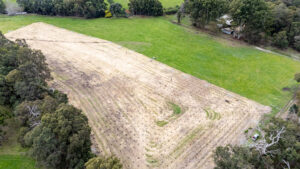
Plant spacing and layout at the trial sites have been informed by fire behaviour modelling and research into vegetation structure and density.
Why this project matters
The South West is facing the combined challenges of a warming, drying climate and increasing bushfire risk, while also being internationally recognised for its extraordinary biodiversity.
The Bureau of Meteorology (BoM) and CSIRO, in their most comprehensive Australian climate projections to date, have suggested that parts of the South West will continue to experience harsher fire weather into the future (Climate Council of Australia, 2015).
In addition, the United Nations’ Intergovernmental Panel on Climate Change (IPCC) continues to identify the South West of Western Australia as a global drying hotspot, supported by Bureau of Meteorology data showing a 20 per cent reduction in rainfall since the 1970s.
Living Firebreaks offer an opportunity to investigate whether bushfire risk reduction and biodiversity outcomes can be considered together. Strategically planted native vegetation may potentially help moderate fire behaviour while also providing habitat and food sources for native fauna and pollinators, improving landscape connectivity and delivering other environmental benefits.
The concept of ‘green firebreaks’ has been explored on the east coast of Australia and overseas however there are no current examples of practice in South West, WA. Therefore, research and on-ground trials are needed to understand its potential, limitations and practical application.
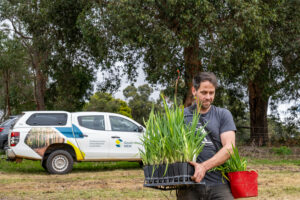
Native species planted at the Balingup trial site were selected for their low-flammability characteristics, biodiversity value and suitability for local conditions.
What we're doing
The Living Firebreaks project brings together research, fire behaviour modelling, local knowledge and practical land management to investigate how Living Firebreaks could work in South West conditions.
The project includes:
Reviewing existing research and working with Murdoch University researchers to identify plant characteristics that influence flammability and suitable Western Australian native species
Working with the University of Melbourne FLARE team to model fire behaviour and investigate how planting density, vegetation structure and layout could influence Living Firebreak performance
Working with landholders to co-design four trial sites at Balingup, Boyup Brook, Quinninup and Narrogin, reflecting local conditions and land management objectives
Establishing managed and unmanaged trial plots and planting more than 6,000 native seedlings across the four sites
Monitoring plant establishment and growth, fuel development, weed management and biodiversity outcomes
Investigating the costs and benefits of Living Firebreaks including consideration of Natural Capital Accounting – is loss of productive land offset by benefits such as shade for livestock or improved soil health
Undertaking landholder and community perceptions of this nature-based approach
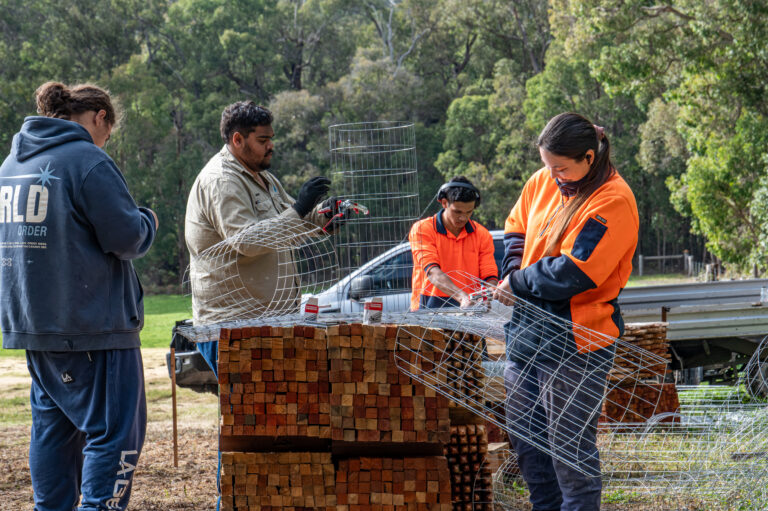
Collaboration has informed every stage of Living Firebreaks, from research and trial design to plant selection, site establishment and planting.
The Living Firebreaks project is delivered in collaboration with NRM Regions Australia with the support of the Minderoo Foundation as part of an ongoing national program to improve awareness, capability, and investment for nature-based solutions that can deliver broad benefits across Australia.