Out-foxing the feral fox

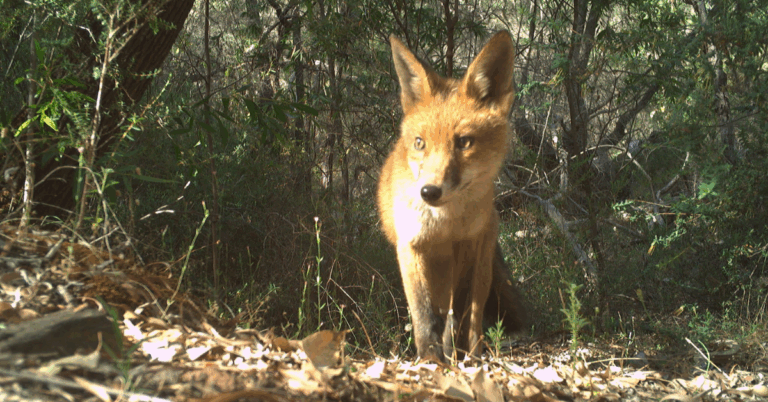
Feral foxes continue to place significant pressure on livestock enterprises and native wildlife across the South West. While tools and technologies have evolved over time, effective fox control still relies on well-planned, targeted approaches that suit individual properties and landscapes. 

As part of South West NRM’s work to support biodiversity protection and sustainable agriculture, managing invasive predators remains a key challenge. Areas adjacent to bushland and conservation reserves remain key in the conservation effort. Reducing fox impacts can play a vital role in protecting vulnerable native species while also supporting farm productivity. 

This previous article from 2020 shares the practical experience of Boyup Brook farmer Marc Deas, who outlines an integrated, on-ground approach to fox management using shooting, thermal imaging, calls and camera surveillance.  

To support landholders in this effort, South West NRM has developed a practical landholder booklet as part of the Saving Native Species in Wellington National Park project. This initiative, delivered in partnership with local landholders and biosecurity groups and funded through the Australian Government’s Saving Native Species Program, focuses on reducing populations of introduced predators and pests such as foxes, feral cats and pigs on private properties adjacent to the park boundary to help protect threatened native wildlife and enhance biodiversity. The booklet provides guidance for on-ground control options and considerations to complement approaches like those outlined above and help you tailor effective fox management on your property. 
The dismay felt by seeing foxes around livestock and predating native wildlife is enough to make most farmers consider a control program. However, feral pest management can be expensive and time-consuming, so it’s vital that farmers choose the most effective strategy.  

One farmer with considerable experience managing pests in the South West  is Marc Deas from Boyup Brook.

After years controlling foxes with a variety of methods including foot-hold traps and canid pest ejectors (CPEs), Marc has settled on shooting as his most effective strategy. However, his approach is much more sophisticated than simply loading a gun.  

Marc’s journey started in South Africa where he worked on cattle and game farms as a manager and hunting guide. After moving to Australia.  

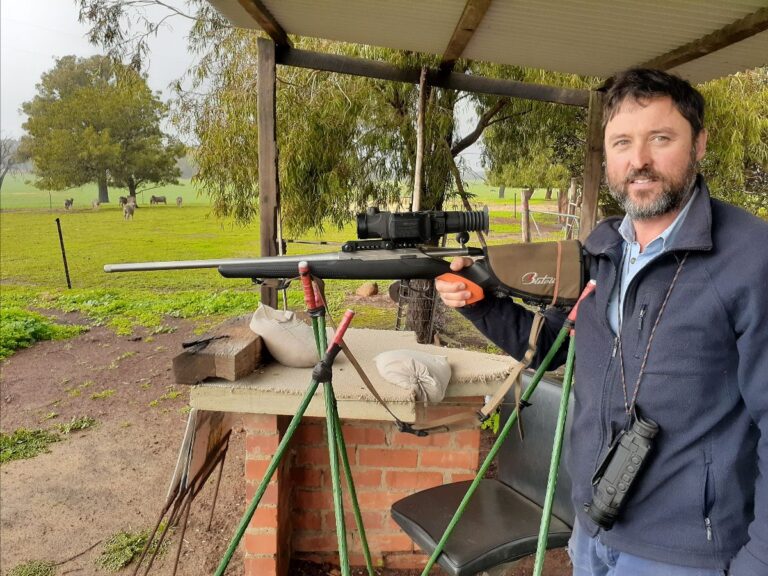
Marc Deas uses a thermal imaging scope and stable shooting sticks to maximise night vision, stealth and accuracy when shooting pests like foxes and cats. 

Marc and Erlanda took over coordination of their local annual “Red Card” fox shoot in 2013.

With their connections to sporting shooter groups, Erlanda’s organisation in matching shooters with local properties, and great community support, the shoot became the most successful in Western Australia.

In 2018, the Boyup Brook fox shoot accounted for 701 foxes, 77 feral cats, 186 rabbits, and five feral pigs in two days. 

At the same time, Marc was fine-tuning his approach to shooting at night, progressing from shooting with a spotlight, trying night vision and eventually settling on thermal imaging. 

“I was going out at night spending two hours with a spotlight. I might see three or four foxes and shoot one,” he said.

“It was a waste of time. So, I decided to get some infra-red night vision equipment. 

Problem-solving

“Night vision needs a light source. Some people have a camera attached to the scope and a screen on top of the rifle, but it lights your face up. It’s a very good option, but it has an external torch. 

“One of the problems is that if the fox isn’t looking at you, their eyes won’t light up.” 

With Marc shooting from the ground to maximise stability, low-growing vegetation was causing white-outs with the night-vision equipment.

To overcome this problem, Marc built a set of shooting sticks to create a stable elevated platform. 

“You don’t want to shoot from an unstable position because you’ll miss or wound,” he said.

“I had used shooting sticks with clients in South Africa, so after a bit of experimentation and talking to mates who used them, I made a set using five stakes tied together. They’re very effective, but you’ve got to learn to use them.” 

Applying thermal tech

With a stable platform at hand, Marc still wanted more stealth and better vision. So, he turned to thermal technology, purchasing a thermal imaging handheld spotter and a thermal scope. 

“The reason I went thermal is because the animal is visible whether it’s looking at you or not. Now I go out on foot and I am completely incognito,” he said.

“On a dark night they have no idea I’m there. All I carry is a rifle on my shoulder, shooting sticks and a spotter, so I can walk anywhere and negotiate fences easily. 

“The handheld monocular is vital because you can’t walk around looking through the scope for  very long! The scope and spotter can both take videos and stills, so I’ve recorded phascogales, possums, bandicoots, and fox behaviour.

“The scope also has a range finder, so I know how far I am from the fox, I know where my bullet is going to fall. At 250 metres distance I’ve got to aim differently compared to 100 metres, so it’s super effective.” 

With thermal imaging monoculars ranging in price from about $1,500 to $6,000 (in 2020), it’s quite an investment.

However, Mark says that with a handheld spotter, the scope doesn’t need to be thermal. 

“You can have a regular scope with a light and headlamp. With the spotter you can get within range before they know you’re there, then flick on the torch and shoot. That’s a very good option.” 

We use cookies

Cookies help us deliver the best experience on our website. By using our website, you agree to the use of cookies. Find out how we use cookies.