
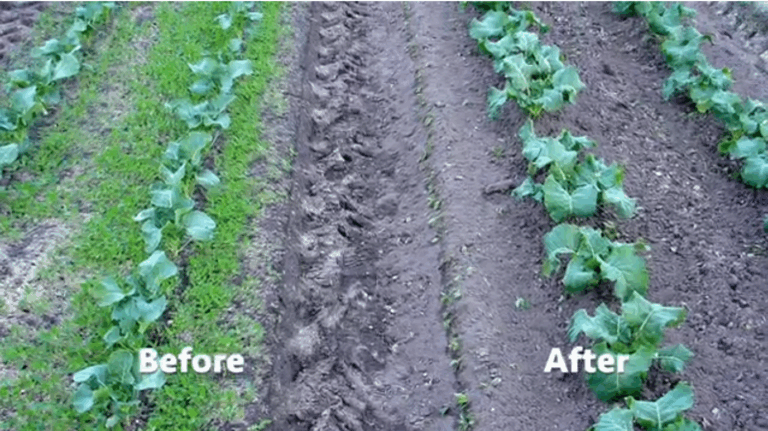
Before and after demonstration of Robert Tucker’s machine through a brassica crop.
Robert Tucker is a South West innovator on a quest to solve weed management in organic or no-spray row cropping.
He has developed an auto-steering, high speed, mechanical weeder that uses radio frequency to track crop rows. Robert has intentionally kept the design at a level that can be built and maintained by farmers, not needing expensive parts or expertise.
Robert says weeding is a major cost in organic horticulture with the amount of crop planted often limited by the farmer’s capacity to control weeds. His intention with this machine was to help reduce input costs and get the best quality produce maintaining good yields.
The machine works via an antenna on the back of a boom that tracks sub-surface irrigation. The idea is that row crops are planted directly above the irrigation line which the machine tracks as a reference point, mechanically weeding everything around it to sub-mm accuracy and at speeds of 8km/hr or more.
Initially, Robert was designing light sensor systems for spot spraying but his time working with the Danish agricultural department changed his trajectory.
“At that time (1999), Denmark was struggling with glyphosate and atrazine turning up in their water supply at 5 times the allowable limit,” he said.
Although spot spraying technology reduces herbicide use it still presents risk for the farmer which is something that has driven Robert towards providing solutions for farmers to move to organic or no-spray systems.
“That was the issue for me, you’re still using chemicals, having to mix it, there’s still the personal exposure to it,” he said.
“That’s why, as a result of the trip to Denmark, I started looking at other avenues of weed control without herbicides all together.”
The Danish ag department wanted to know if Robert could use the light sensor technology that he had developed for green-on-green spot spraying, for locating crop rows, which is what started the process of developing the system he is working on now.
“Rather than looking for particular plants or weeds within a crop, we were looking to find the crop row and use that as a reference point for steering the implement,” Rob said.
But there were limitations using vision systems. The advantage of a radio frequency system is it’s not affected by weed density or environmental conditions.
“That’s what I love about RF, there’s a fixed reference point that doesn’t change no matter day or night, light, no light, rain, wet, dry, it’s always 100% reliable, it’s accurate in terms of a precision guidance system,” he said.
“The other advantage with tracking subsurface irrigation is the speed. There’s no way you could get that speed using camera vision or spot spraying, once your weed density gets up, you’re at less than a walking pace.”
As usual, it’s not a one size fits all and its current application is limited to horticultural row crops but Robert’s work highlights how practical, farmer-led innovation can drive meaningful change in farming systems.
The technology is at prototype stage awaiting manufacturing opportunities.
For more information about the technology, its application or to express interest about a demonstration day, contact our Sustainable Agriculture Team.
To me, the mallee is the perfect solution because we can get an income from it and it creates opportunities for regional communities, so it’s not such a big loss. We can also make fuel out of these trees to address our fuel issues.
Unfortunately, the oil mallee industry has not achieved its targets. It’s well perched for carbon and liquid fuels, but the original program of trying to get 10% of the vegetation back across the landscape, we’re hardly 0.001% because people have lost confidence in it due to a lack of commercial outcome and public policy support.
But, now as more things align such as carbon, fuel insecurity, rural revival and the need to restore the landscape for long-term productivity, there is increasing opportunity.
It just comes down to getting the right support in the right place with the right mindset so we can create a new reinvigorated future for regional Australia.
Where to get your trees
If you’re looking to incorporate trees and shrubs this spring here are a couple local nurseries to check out:
Blackwood Environment Society
Selling plants endemic to the Bridgetown Greenhouses area.
They are currently taking orders for the 2025-25 season, please email nursery@blackwoodenvironmentsociety.org.au for a plant order form.
Geographe Landcare Nursey https://gcln.org.au/
Katanning Landcare
Planting equipment for hire including a Chatfield Tree Planter to help get lots of trees in the ground this season.
This article is shared as part of South West NRM’s Sustainable Agriculture Facilitator role which is supported by the Australian Government through funding from the Natural Heritage Trust under the Climate-Smart Agriculture Program.