
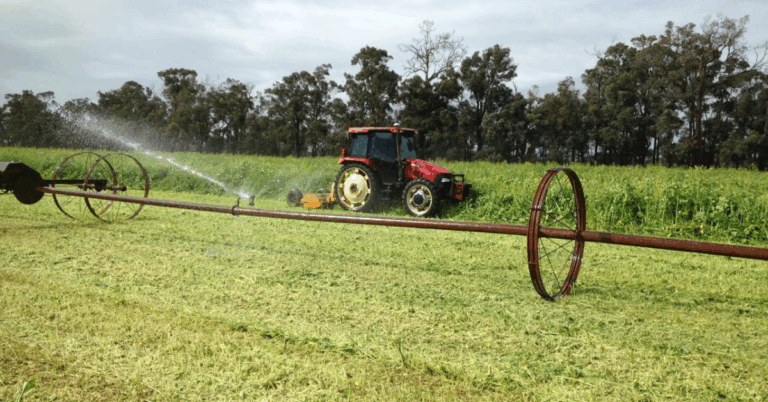
From Gut Instinct to Real-time Data
Water availability in the South West of Western Australia has been declining for decades.
Since the 1970s, rainfall has dropped significantly, reducing how much water is stored in landscapes, rivers and groundwater systems. For growers, this has made water one of the most critical and uncertain resources on farm. So how can farmers make confident irrigation decisions when water is becoming scarcer?
That question sits at the heart of the On-Farm Water Demand project, discussed by Professor Mark Gibberd and Dr. Julia Easton in this Dry Season Resources podcast episode.
The project began after strong concern from industry and the community about future access to water. While there is extensive data on rainfall trends and environmental water use, there has historically been very little independent information on how much water agriculture uses, and what that water delivers in return.
To help address this gap, the project worked with a group of “champion” farmers to test new tools and approaches. Starting with six farms and later expanding to 27, the project focused on key South West crops including avocados, apples, wine grapes, truffles and potatoes, commodities that are central to regional production.
The first step was installing soil moisture probes and irrigation flow meters on selected horticultural blocks. These sensors fed real-time data into a digital platform, allowing growers to see how much water was being applied each day, alongside predicted crop water demand based on soil moisture and evapotranspiration. This meant farmers could look back at what they had irrigated today and also plan for the coming days and weeks.
Importantly, the data didn’t replace farmer judgement. Instead, it helped support and validate decision-making. Growers could choose to apply more or less water depending on their strategy, but now those choices were backed by numbers rather than guesswork.
Over four years, the project captured data across very different seasons — from extremely wet years to the hottest on record. This allowed the team to build a clear picture of how water use varies by crop, season and irrigation approach.
For many growers, the biggest benefit came at the end of the season. By reflecting on water use, yield and costs together, farmers could better understand where water was delivering value and where improvements could be made.
Beyond individual farms, the project also explored how this information could be scaled up.
Using machine-learning crop classification and remote sensing, the team mapped the footprint of major crops across catchments. This made it possible to estimate regional water demand by crop type and season, a key step toward broader planning and future modelling.
Looking ahead, the data can be used as benchmark information to explore how water demand may change under future climate conditions, where pressure on water resources may increase, and where irrigation efficiency could help manage risk or support future production.
For more information, visit this page.
South West NRM is the Peel and South West Node of the South-West WA Drought Resilience Adoption and Innovation Hub and receives funding from the Australian Government’s Future Drought Fund.