
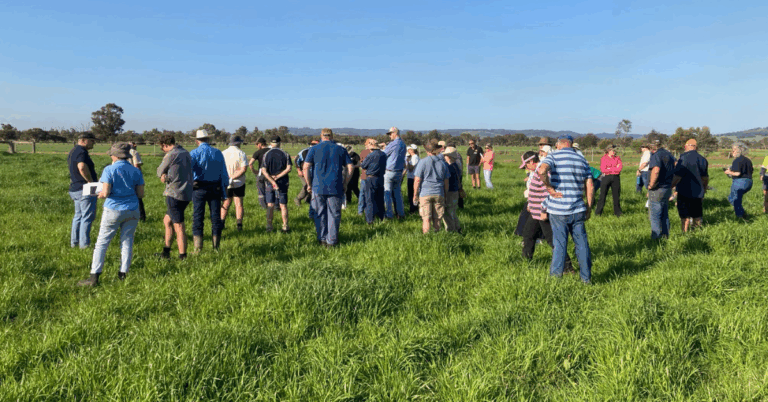
Participants at the Western Beef Association’s Walking Outside the Box field day checking out
practical ways to manage kikuyu in production systems. Photo taken on 23rd Sept 2025.
Managing kikuyu is one of the most common challenges faced by farmers in high rainfall areas of Western Australia.
To address this, Western Beef Association hosted an event on 23 September, 2025 with farm manager Mike McLaughlin, who shared practical insights on how to effectively manage and make the most of kikuyu within a production system.
The problem with kikuyu
Mike says the problem with kikuyu is it’s highly competitive but not highly digestible or high in energy.
So, it needs to be managed in a way that reduces its competitiveness and allows space for more digestible feeds higher in energy such as clover to establish. He accomplishes this through strategic grazing pressure with very high stocking rates.
“The more animals you have, the better it works,” Mike said.
“Kikuyu and clover like to get chopped up and can come back with a long rest period.”
Mike aims for a 42-day rotation for beef cattle (time for kikuyu to grow six new leaves), and a 35-day rotation for dairy cattle (5-leaf stage). The fifth and sixth leaves tend to be more fibrous and less digestible.
“The clover plant will like what you’re doing and will start to flower and set seed. The cows will spread it wide over the property. If you don’t have clover, you’ll have to introduce it,” he said.
Mike stocks his kikuyu at 5-10 head per hectare and aims for a two-day grazing period for beef, and a one-day graze for dairy. At this intensity, plants are stripped of leaves in day one and sugars accumulate in the stem in preparation to grow new leaves.
Mike believes a second bite at this stage will wound the kikuyu and give the clover a competitive advantage.
Management for dairy cows vs beef
Event host Jeisane Accioly explained why beef cattle are more appropriate to use for the second bite.
“Dairy cows have a higher quality requirement, so the plan with dairy cows is to leave the stalks behind, but with beef cows you want to eat the whole thing,” she said.
Mike rotates other cattle behind his milkers to enable the second bite and says they do really well on the stalks.
Another key tip Mike shared on the day is that the sugar content in kikuyu is highest in the afternoon.
“It builds sugars more and more as the sun comes up,” he said.
“So, between about 2 and 6pm it has very high sugar levels. Always put the cows into the paddock at 2pm and they will get more energy (because they graze more vigorously).”
Nitrogen?
Kikuyu thrives on nitrogen, so Mike recommends avoiding nitrogen fertiliser applications on paddocks where you are trying to suppress kikuyu growth.
Clover fixes its nitrogen requirements from the atmosphere so not adding nitrogen fertiliser can give your clover a growth advantage.
In summary
Managing kikuyu successfully comes down to suppressing its rigorous growth whenever possible.
Intensive grazing combined with long recovery periods can supress the dominance of kikuyu and encourage clover, turning kikuyu from a frustrating weed into a useful part of a productive feed system.
This event received funding from the Grower Group Alliance through the Evergreen Farming Legacy Fund.