
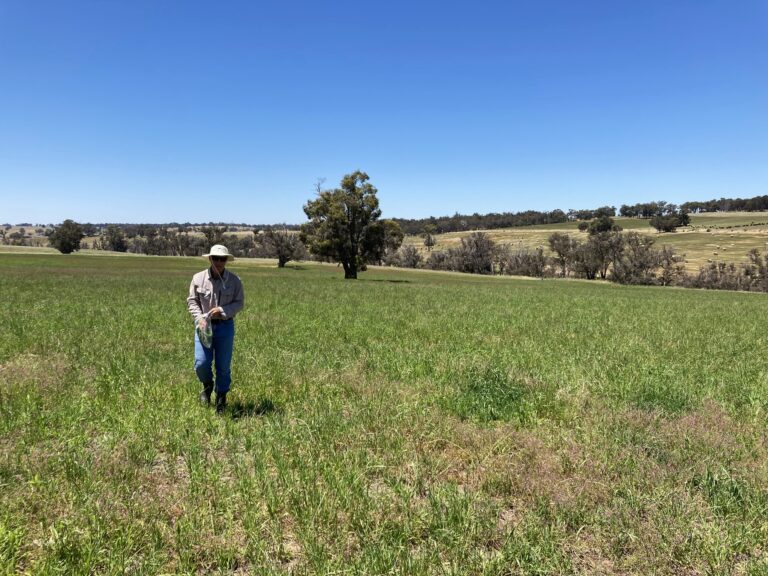
Sustainable Agriculture Manager Peter Clifton collecting feed samples
from a perennial pasture in Boyup Brook on 11th November 2025.
We’re testing the feed quality (eg. energy, protein) of perennial pasture versus annual pasture across the seasons thanks to a grant from the South West Drought Hub and undertaken as part of our Hub Drought Node role.
Tests will compare feed in late spring, mid-summer and early autumn. And we’ve just collected the first samples.
Sustainable Agriculture Manager Peter Clifton said he hoped results of the feed tests would help growers better understand the value of perennials as a feed source in drier months.
“Establishing perennial pastures is challenging, so for farmers to commit, they need to understand the rewards to incentivise overcoming those challenges,” he said.
“Demonstrating the feed value of perennials on the shoulders of the growing season, or after summer rain events, may encourage producers to look harder at how they can be incorporated into their system.”
Pasture samples will be taken from farms participating in South West NRM’s FEaST 2030 perennial pasture demonstration, which is measuring the establishment and persistence of perennials over the next two and a half years.
Those demonstrations will also document best practice establishment and management of perennials.
“The demonstration farms all have a slightly different mix of perennials,” Peter said.
“The energy, protein and fibre of each mix will be compared to a neighbouring paddock of annual pastures, which will vary in its composition depending on weediness.”
Results from feed tests will be incorporated into the Rumen8 software program to help producers refine supplementary feeding and meet production targets cost-effectively.
To learn how to feed cattle over summer cost-effectively, come along to our Rumen8 workshop on 15 December, delivered in collaboration with Western Beef Association, for an introduction to the software.
South West NRM is the Bunbury Node of the South-West WA Drought Resilience Adoption and Innovation Hub and receives funding from the Australian Government’s Future Drought Fund.