About the project
South West NRM’s Farm Efficiencies & Sustainability Towards (FEaST) 2030 project supports farmers across the South West region to build resilience to climate change and reduce emissions, while adopting sustainable farming practices that create dual benefits for agricultural production and the environment.
FEaST 2030 forms part of the Australian Government’s Climate-Smart Agriculture Program, a five-year investment through the Natural Heritage Trust designed to drive agricultural sustainability, productivity and competitiveness.
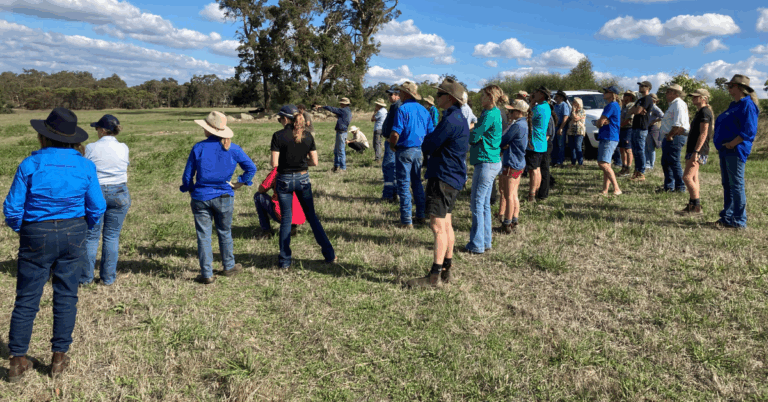
On-farm learning and knowledge sharing are an important part of FEaST 2030, helping farmers explore practical approaches to improving resilience, efficiency and sustainability.
Why this project matters
Climate change is putting increasing pressure on farming systems, particularly water, pasture and feed. Farmers need to maintain productivity and profitability under increasingly variable conditions.
Building resilience also means protecting and making better use of the natural resources agriculture depends on. Better management of water, soils, pastures and biodiversity can help farms adapt to changing conditions while supporting long-term productivity.
The IPCC has identified a significant long-term drying trend in south-west Western Australia, while BOM data has reported that April to October rainfall has declined by around 16% since 1970, placing increasing pressure on feed and water security.
Agriculture also has a role to play in Australia’s transition to a lower-emissions economy. High emissions reflects inefficient production, so by improving production efficiencies, we can both improve profitability while also reducing emissions. Reducing on-farm emissions can also help farmers respond to market opportunities and changing sustainability expectations.
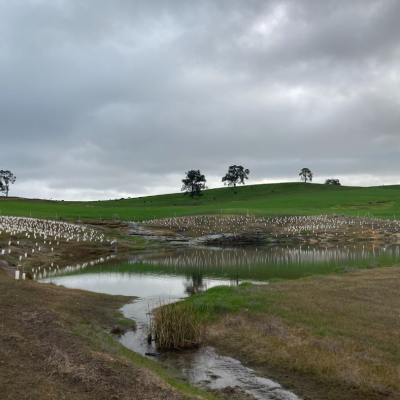
Enhancing farm dams through revegetation is one of the practical approaches being explored through FEaST 2030.
What we do
Across the South West region, our FEaST 2030 project supports a diverse agricultural area stretching from Bunbury to Walpole, to out past Narrogin, Dumbleyung and Katanning. The project focuses on four areas:
- Farm water security and efficiency to support better decisions about water capture, storage and use, including technologies that improve irrigation efficiency.
- Fodder quality and feed budgeting to help farmers manage longer dry periods, maintain livestock production efficiencies and reduce emissions.
- Drought-resilient perennial forage systems to build knowledge and confidence in their adoption while monitoring potential impacts on soil carbon.
- Enhanced farm dams to improve habitat, biodiversity and water quality, with potential benefits for livestock production and reduced methane emissions.
Resources
Explore resources developed through FEaST 2030 across the project’s four key areas of activity.
Farm Water Security and Efficiency
Article April 2026: Making farm dams fit for the 21st century
Case Study June 2026: Are your farm dams still fit for purpose?
Case Study June 2026: Soil Moisture Sensors and Solar Pumps Build Orchard Resilience
Livestock Production Efficiency
Case Study June 2026: Improving Hay Quality and Grazing Management at Belvedere Family Enterprises
Article September 2025: Survive the dry by producing better hay and silage
Case Study August 2025: Benefits of measuring farm emissions
Video September 2025: Aims and Benefits of Measuring Farm Emissions
Perennial Forage Systems
Article June 2026: Nutritional Value of Annual vs Perennial Pastures in South West WA
Article May 2026: Hybrid Ryegrass a perennial compromise, but grazing management still key
Report 2026: Perennial Pastures in SW WA: A Review
Article 2025: Interest high in “The Perennial Question”
Enhanced Farm Dams
Article September 2026: Enhanced farm dams: Results from year 1
Enhanced Farm Dam: three-part series
- Part 1: Benefits and Costs
- Part 2: Planning and Preparation
- Part 3: Long-term Management and Maintenance
Article April 2026: Enhanced dam doing swimmingly
Article August 2025: How to revegetate a farm day
Project update July 2025: EFDs for stock water quality and biodiversity
Project partners and funding
FEaST 2030 is delivered by South West NRM in collaboration with regional partners, helping to deliver practical activities, workshops and resources for farmers across the South West.
The project is supported by the Australian Government through funding from the Natural Heritage Trust under the Climate-Smart Agriculture Program and delivered by South West NRM, a member of the Commonwealth Regional Delivery Partners panel.