
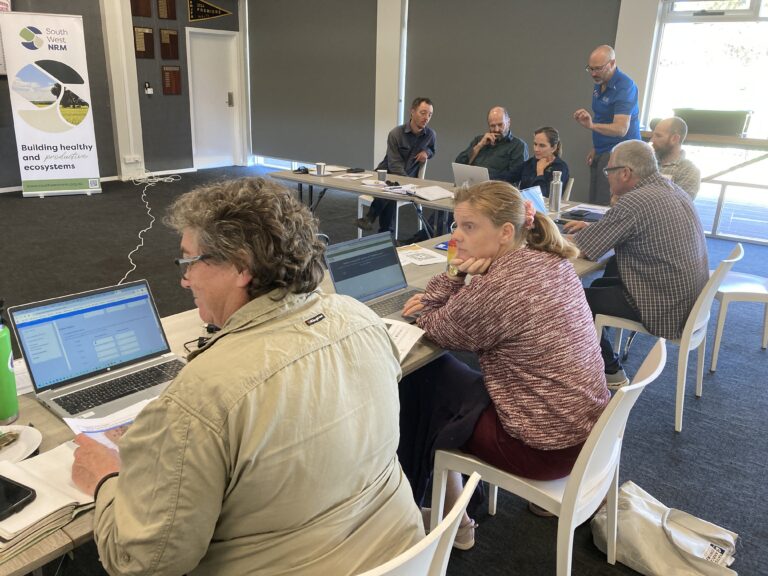
UWA Professor Nik Callow (standing) at a Water Security Workshop organised by Southern Dirt as part of our FEaST 2030 Project.
Are your farm dams still fit for purpose?
That was the question posed by UWA’s Professor Nik Callow at Southern Dirt’s Water Security Workshop, held in March at Kojonup as part of South West NRM’s FEaST2030 project.
“DPIRD (Department of Primary Industries and Regional Development) worked out that there’s about 185,000 farm dams in WA,” Nik said.
“They represent somewhere in the order of about 10 to $15 billion worth of investment by farmers in water infrastructure. Many are small and built decades ago and fall over in anything below about a decile 3 to 4 year.
“So we’ve got a lot of residual infrastructure out there, but farming systems have changed, rainfall patterns have changed, so are they still fit for purpose?”
Changes in farming systems and rainfall intensity has resulted in less run-off into dams. Now, having surfaces such as roaded catchments engineered to produce run-off from smaller rainfall events is becoming critical for secure water supply.
“If we’re talking about roaded catchments, you typically need 8 to 12 mm of rainfall in the day (to get runoff into dams),” he said.
“Compare that to a natural pasture catchment where you need about 25 mm of rain. The number of 25 mm rainfall days now compared to 1980 or 1990 has really pulled back significantly.”
For example, Nik described a site east of Esperance that only had three rainfall events that would have generated run off from a roaded catchment, and no run-off from a pastured catchment.
“Effectively, the water infrastructure that we build or inherited from the 1960s, 70s and 80s doesn’t really function anymore, and that’s a critical gap,” Nik said.
“We don’t still farm like we did in the 1970s, so we can’t expect 1970s water infrastructure to still be fit-for-purpose!”
WaterSmart Dams
That gap started to be filled through the recent WaterSmart Dams project that involved 12 demonstration sites and the development of a farm-based water planning tool called the Water Evaluation Platform.
Nik and partners including four grower groups were involved in monitoring demonstrations that looked at a variety of techniques to improve water capture and conservation (reducing evaporation).
Considering options
“A key option is people pivoting to high-performance engineered catchments using products such as repurposed PVC tarpaulins and HDPE that run water on just 1 mm of rainfall,” he said.
The trial of 22 repurposed PVC tarps sown together and laid on a smooth graded surface at Jacup in the Shire of Jerramungup, captured 88% of the 413 mm of rainfall. If the site had relied on the old roaded catchment with an 8 mm threshold, only 56% of the rainfall would not have reached the dam, and with a much lower proportion of rainfall turning into runoff.
This trial also showed that, second-hand PVC tarps may not be the greatest solution, particularly when not weighed down properly, as they can become very dangerous if caught by wind.
“A key lesson from this site was that weights like tyres should be placed on top, and there is a need to use a professional installer who’s got that stitching experience and equipment to do these things, and you do need the right conditions,” Nik said.
But a bigger problem is their longevity.
“At this particular site the tarp only lasted about 2 years as the quality of the tarps was quite poor. While other sites with second-hand PVC tarps are still doing well, the key lesson is that second-hand PVC tarps might be a bit of a false economy. While they are cheaper than brand-new HDPE, there is a lot of costs in the underlying earthworks, so total costs and the unit-cost of water across the lifespan of the product is important to consider when making an investment decision,” he said.
Instead, interest is turning towards HDPEs (High Density Polyethylene).
“It’s a much hardier, more robust, thicker product. It’s performance for water management is very similar or even better compared to PVC tarps. They are being installed elsewhere in Australia including South Australia, and are also used by Water Corporation and the mining industry. Commercial installation costs can be as low as $5-7m2 installed (not including the earthworks) and some come with a 10-15-year manufacturer warranty.”
But capturing more water isn’t the only option open to growers. Other options focus on reducing evaporation with dam covers and fixing leaks in the dam.
“We found between 1.4- 1.6 metres of evaporation from dams, so around 50% of the water in a 5 ML dam is lost to evaporation in a year, and then leakage on top can be another 30-50cm or higher of additional lost water,” he said.
“We did some work with daisy dam covers that float on the water and are anchored on the sides. They came in at about $15 m2 and reduced evaporation under the covered area by 70%.”
Other options such as hexa-cover product are more expensive and probably not viable for agricultural enterprises. Pour-on polymer liquids that float on the dam surface have been found by other research to also have poor performance and reduce evaporation by less than 10%, don’t work in windy conditions and require frequent re-application and problems integrating then with livestock.
Leakage reduction products can be a useful options as they flocculate clay material that then clogs fractures and leaks in the dam base.
“Some of the economic analysis suggests that leakage-reduction may be one of the cheapest ways to get more water in your system,” Nik said.
Farmers have several options to improve water security that all come with different costs and effectiveness depending on where you farm. There is no single right or wrong answer and people need to consider their individual circumstances, their farming systems, and water needs.
Free online platform
To deal with this complexity, the Centre for Water and Spatial Science at UWA developed the Water Evaluation Platform (WEP) as part of the WaterSmart Dams project.
The WEP is a free online platform for evaluating water security that helps farmers size catchments and dams to meet their water needs, and simulates the costs and benefits of different interventions.
Southern Dirt’s Water Security Workshop during March in Kojonup as part of the South West NRM FEaST2030 program, was an opportunity for growers, agricultural advisors, grower group and NRM staff to join Professor Nik Callow and learn how to use WEP for running simulations on their own properties or projects to look at water security options, solutions, and potential costs.
The platform uses historical and localised daily climate data, and allows users to create their own profile for livestock, spray water or other water demand, to run scenarios to see how effective different interventions would have been in the past, and therefore how effective they will be in the future. It shows how reliable a solution would have been or when it would have run out of water and provided an estimate of the costs of various potential options, including roaded and engineered catchments, and also evaporation reduction.
Choosing the historical rainfall years used in scenarios can be critical.
Nik explained to the audience there was research showing there had been statistically significant hydrological changepoints in rainfall and runoff that occurred around the millennium, so it was recommended to run scenarios on post-2000 rainfall.
“We’ve got compelling evidence through pretty much all of the South West to show there have been significant changes in rainfall and runoff behaviour in natural and agricultural catchments since 2000,” he said.
“While you can run scenarios for many decades or a hundred years, the most realistic results for the current climate will come from using post-2000 climate data.”
The Platform requires some infomation from famers depending on the scenario. Designing an optimal catchment and surface for an existing dam will require dam dimensions that can be read from Google Maps or similar or measured in the field, and the tool allows the user to just draw in the catchment area.
Water demand is also required and is based on monthly stock numbers on dams, or water use for spraying or irrigation.
The model uses daily temperature data to predict livestock consumption using the best available science, but users can over-ride default values and enter in their own consumption figures. WEP includes an estimation of costs based on the demonstration sites that were developed in the WaterSmart Dams project and quotes form contractors, but users can also update with their own local costs or quotes.
“For all the default values (including water demand per head), we’ve gone to the best available science, and to quotes from contractors in WA. We’ve gone to the livestock scientist, we’ve got quotes, we’ve gone wherever we can to get the best values, but you can override them (if you have other costings),” he said.
“This means you should get realistic estimates of water and costs from the model simulations.”
The platform contains a leaky dam evaluation tool and a separate tool to evaluate the effect of using dam covers for evaporation.
“We’ve tested evaporation with floating weather stations and tested different evaporation algorithms and we’re pretty comfortable that those algorithms are fit for purpose,” Nik said.
“The results we get from running WEP simulations on our project demonstration sites, directly matches water level and evaporation data the UWA team measured from monitoring across multiple years.”
Help with the WEP Tool
The water evaluation platform is available here. South West NRM has also developed a workbook guide for first time users here.
One important final point from Nik was on using the tool outputs and engaging with contractors.
“The WEP tool allows you to understand the size of dam or catchment that will be optimal for your circumstances,” he said.
“You can ensure you know the size of catchment needed to fill you dam, or what size to clean and enlarge a dam to work with an existing catchment when you are having a conversation in the paddock with your contractor.
“We’ve seen some examples of contractors with their own ideas such as overly steep roaded catchments or not using silt traps, that are not best-practice and have led to erosion and very turbid dams that rapidly fill with sediment. We would strongly urge people to read through the best advice available from DPIRD on both dams and catchments, and implement these when building water infrastructure.”
Further Resources
Article: Stock water just as important as genetics
Project: Farm Efficiencies & Sustainability (FEaST) toward 2030
Case Study: Are your farm dams still fit for purpose?
WEP Project Resource: Water evaluation platform workbook
South West NRM’s FEaST2030 project is supported by the Australian Government through funding from the Natural Heritage Trust under the Climate-Smart Agriculture Program.