
We’ve heard a lot about perennial pastures recently, but have you ever heard of hybrid ryegrass?
A perennial and annual compromise
A hybrid is a cross between a perennial and Italian (annual) ryegrass that lives for two to five years but typically has faster early growth and competitiveness compared to a fully perennial ryegrass.
Different varieties with varying levels of perennial parentage are available and have been trialled by local dairy farmer Garry Haddon south of Busselton.
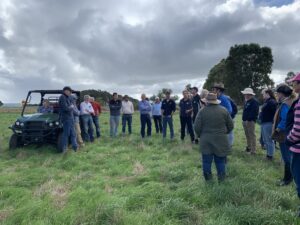
Garry’s agronomist Graham Mussell spoke at a recent Geocatch Field Day about the trials and said hybrids can be a nice compromise if you’re looking to move from an annual towards a perennial system.
“I think if people are comfortable with annual ryegrass and like the production they are getting from them, hybrids offer a step towards longevity, for two to five years, without foregoing as much production loss in the first year that a fully perennial ryegrass may have.”
The challenges of perennial establishment
The establishment year is often a key barrier to adopting perennials, with producers having to accommodate around 60% less grazing in that year. Another barrier is the cost of seed.
“Using information from growers involved in South West NRM’s perennials project, the average cost of the perennial seed was about $300 per hectare, compared to a good annual costing about $150 per hectare, so it’s twice as much. And from past research, the payback time is 2 to 3 years if you’re going into a degraded, poor annual pasture paddock. But if you’re going into a good annual pasture, the payback time can be as long as 6 or 7 years.”
Perhaps the biggest barrier is the risk of failed establishment. So minimising competition from weeds and grazing perennials appropriately are critical. Graham said that hybrid trials on the Haddon property over a number of years have been more successful that straight perennials.
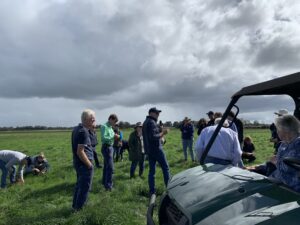
“The hybrids do seem to persist quite well for 3 or 4 years, whereas when we tried to grow a full perennial ryegrass, for whatever reason, maybe our grazing management in spring hasn’t been ideal, the persistence is not as good as it is with a hybrid.”
Why grazing management matters
Grazing management is a key factor in the success of perennials. Graham outlined how perennials need to accumulate carbohydrate reserves to survive the long hot summer. That means only grazing after reserves in the base of plants have been replenished. For ryegrass, that occurs when tillers have grown three new leaves.
Carbohydrates also encourage tiller production that helps perennials like ryegrass, cocksfoot, phalaris and tall fescue to expand. Because tillers grow from the crown of the plant, it’s critical not to graze down to the crown. However, because phalaris has growing points beneath the soil, it can tolerate heavier grazing once established.
When carbohydrate levels exceed what is required for leaf growth, rhizomes (underground stems) can grow and form new plants. This is how phalaris and tall fescue plants can expand. For ryegrass and cocksfoot, the emphasis is more on seedling recruitment.
Spring management influences summer survival
“In spring, the grazing management is often left unchecked. But research shows it’s important to let the temperate perennial grasses set seed allowing dormant tiller buds to form that helps the plant survive the summer which is critical for persistence over time.”
Seed set means there will be a significant amount of dry residue such as seedheads around plants. This can reduce early season growth due to the lack of light penetration.
“You need to manage that dry residue with either grazing or machinery over the summer to ensure that when the break of season happens, the plants have the best opportunity to jump away and provide early feed that perennials are so useful for.”
For more information, see mla-how-do-i-optimise-perennial-grass-management-in-late-spring-and-summer.pdf which includes links to get perennial grasses to thrive and survive, and how to remove excess pasture.
SouthWest NRM’s FEaST Project is supported by the Australian Government through funding from the Natural Heritage Trust under the Climate-Smart Agriculture Program and delivered by South West NRM, a member of the Commonwealth Regional Delivery Partners panel.