
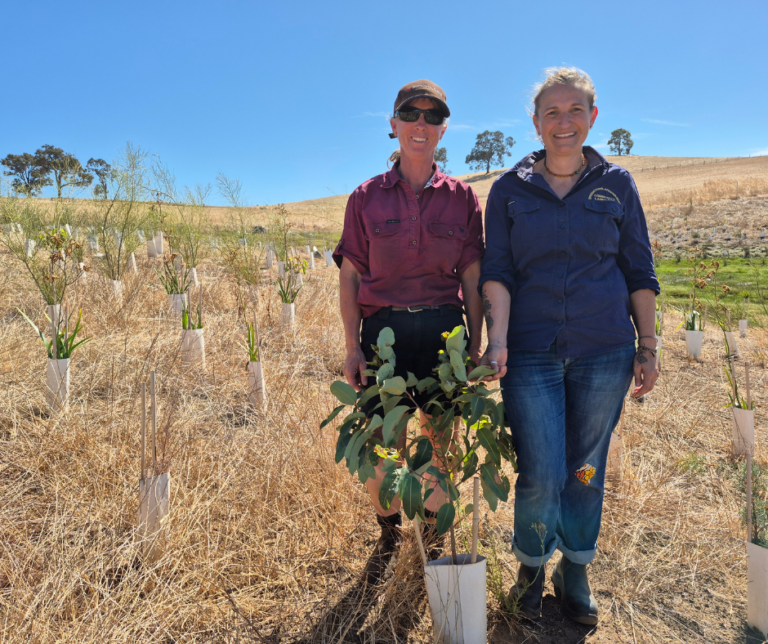
Dam owner Paula Waters (left) and Blackwood Environment Society’s Karrie Williamson checking on progress of the seedlings.
Early signs suggest that fencing and revegetation of farm dams under South West NRM’s FEaST2030 project is a huge success!
The local community was invited to one of the dams at Sunnyside in late March, 2026 to view results, and left inspired to undertake similar projects on their own farms.
The planting was designed and conducted by Blackwood Environment Society (BES) and was described by their Chair and reveg expert Jenny Dewing:
“We’re very pleased with the way the vegetation’s growing, we were a little bit nervous because the water (level) went up after the plants went in and some of them were sitting over their heads in water for a few months, but they’ve all come out and even though we’ve had an incredibly dry summer, nearly four months of dry weather, the plants have just soldiered on and are looking fantastic,” Jenny said.
“I’m guessing, over 90% success rate!”
According to the dam owner
The dam’s owner Paula Waters was equally excited about the project and how it has helped water quality and lamb productivity.
“So before, all summer the sheep just hammered any green patch and those patches were harbouring internal parasite eggs, and they were just building up in the stock, and then we were having a lot of stock losses,” she said.
“Now that the dam is fenced and they’re excluded from those areas, we’ve had a lot less deaths and our worm egg counts are lower.
“Not to mention the fact that the dam area itself is just enhanced beautifully.
“We’re just blown away with this success and the amount of survival of the seedlings in the first 8 months.”
The recipe for success
Jenny explained some of the reasons for the successful plant establishment – coordinated by BES Landcare Officer Karrie Williamson.
“Well, the site preparation was excellent,” she said.
“The seedlings were excellent and the volunteers were excellent. We really need to bring the volunteers back to see how effective their planting was, because they worked hard for 3 days on it and they did a great job.”
The benefits for livestock
Earlier in the day, attendees heard how improving water quality can help livestock production through a presentation from local DPIRD vet Hayley Hardwick.
Hayley said water quality is the first limiter of feed intake.
“With low water quality, livestock drink less, and when they drink less, they eat less, lose condition and don’t make enough milk,” she said.
“So arguably water is the most important nutrient for livestock, but we often overlook it.
In WA we’ve got the usual suspects, our salinity, our algae and other contaminants that can cause diseases like botulism and salmonella and increase the risk for Avian influenza. “
The problem with South West dams
Hayley discussed common issues in South West Dams, including salinity.
“Salinity is one of the most common issues we face and can have a big impact on livestock performance.” she said.
“At higher levels, salinity becomes more than just a production issue, it could lead to something called salt toxicity or salt poisoning.”
One of the challenges is that salt tolerance varies with different stock classes, especially sheep.
“Young animals, pregnant and lactating stock are far less tolerant to salt than dry mature ewes,” Hayley said.
Dam water can also increase the risk of disease.
“The first is blue-green algae. Livestock can be poisoned by drinking water that’s contaminated with blue green algae and their toxins, (caused) by plant nutrients, organic matter, faecal matter, phosphorus or nitrogen,” she said.
“So our risk factors include warm temperature, nutrient runoff after rain, and a lack of water movement as well.”
While there are chemical options for treating blue-green algae such as copper sulphate and Simazine 900 WG, they can have side effects such as copper toxicity and impacts on other life such as yabbies
Another prevention option is barley straw that was used successfully by our farm host Paula.
“Within a week (the algal bloom) cleared up and cattle improved. They were staggering and scouring, and algae was clear on the dam, so it was quite a rapid response,” Paula said.
Hayley knows from experience that prevention is easier than treatment and suggested that preventing organic matter from getting into the dam is the most important thing.
In conclusion
Hayley emphasised the importance of water quality on livestock production.
“Even before we see clinical signs, they’ll be drinking less and eating less,” she said.
“Organic contamination in dams increases our risk of avian influenza, salmonella and botulism.”
Hayley also emphasised the importance of reporting unusual signs like neurological signs in animals to your local private vet or your local DPIRD field vet.
If you want to sample your water for blue-green algae, contact your local DPIRD office.
For more details on revegetation, see last year’s article developed with Jenny Dewing and the Blackwood Environment Society.
South West NRM’s FEaST2030 project is supported by the Australian Government through funding from the Natural Heritage Trust under the Climate-Smart Agriculture Program.
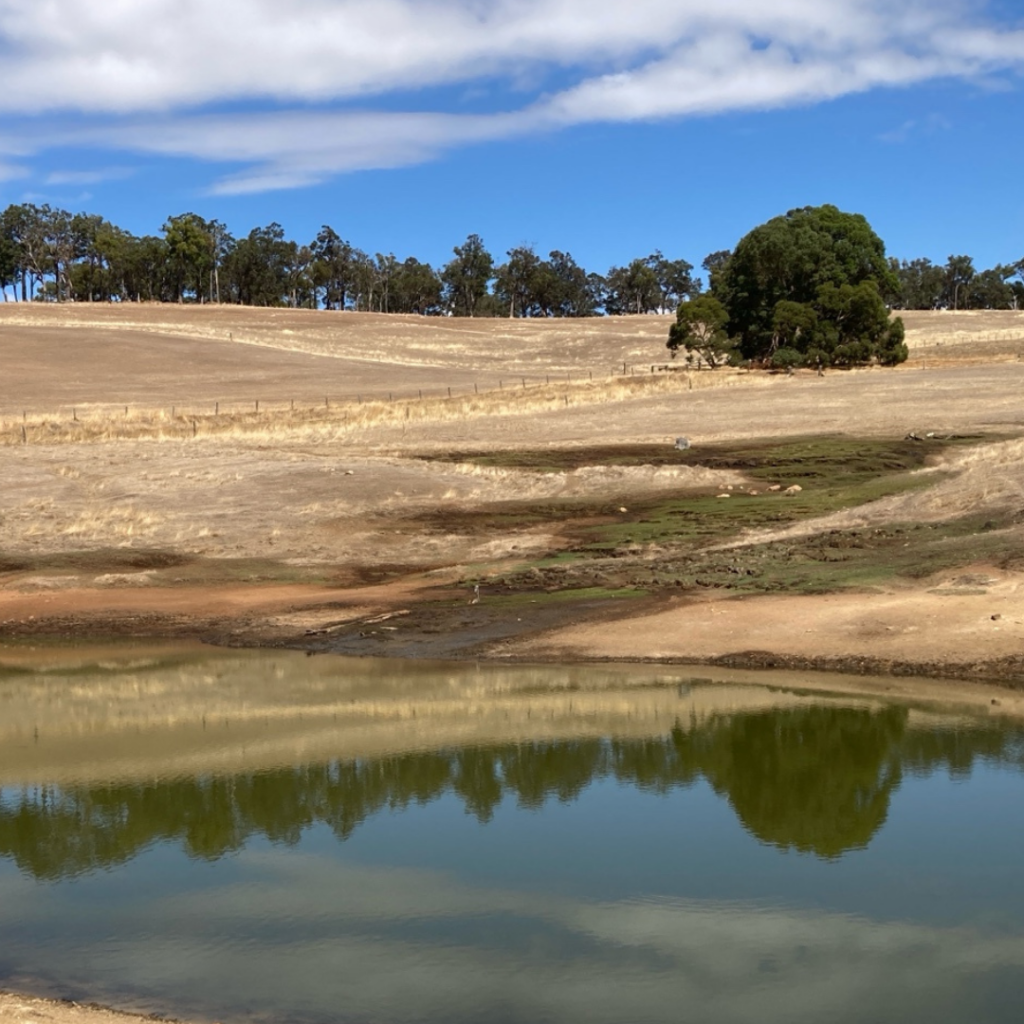
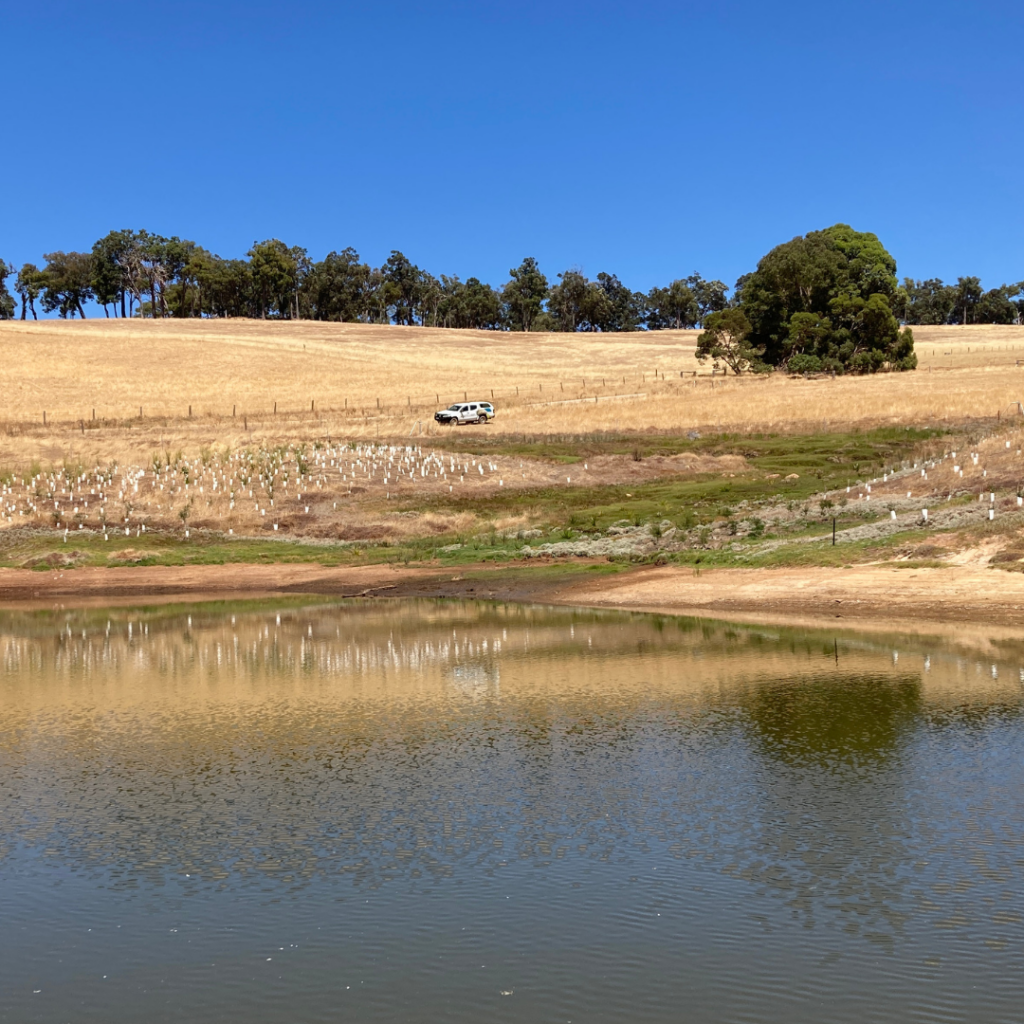
Paula Water’s dam before and after revegetation.