
Overview of Study
South West NRM’s comparison of perennial and annual pasture quality has been completed.
This study compared the forage quality of perennial pastures and annual pastures on six south west Western Australian livestock properties at three time periods:
- November 2025 (11/11/25 to 09/12/25): At this time, annuals were maturing more than perennials, with the former drying off (e.g. 10% less moisture content).
- April 2026 (10/04/26 to 21/04/2026): The season broke on 28 March with 40-60 mm falling across all sites over two days. Annual pasture samples were of dry biomass from the 2025 season because new annuals were only just emerging. In comparison, fresh perennial regrowth was sampled because their faster growth rates and bigger root systems meant they were ready to graze earlier.
- May 2026 (29/04/26 to 26/05/26): Fresh annual and perennial pasture growth from the 2026 season was sampled. It was noticeable in May that annual plants were still very easy to pull out of the ground, while perennials were much better anchored.
The properties are located near the towns of Boyup Brook, Brunswick, Busselton (Sabina River) and Manjimup (Perup, Wilgarup and Cosy Creek).
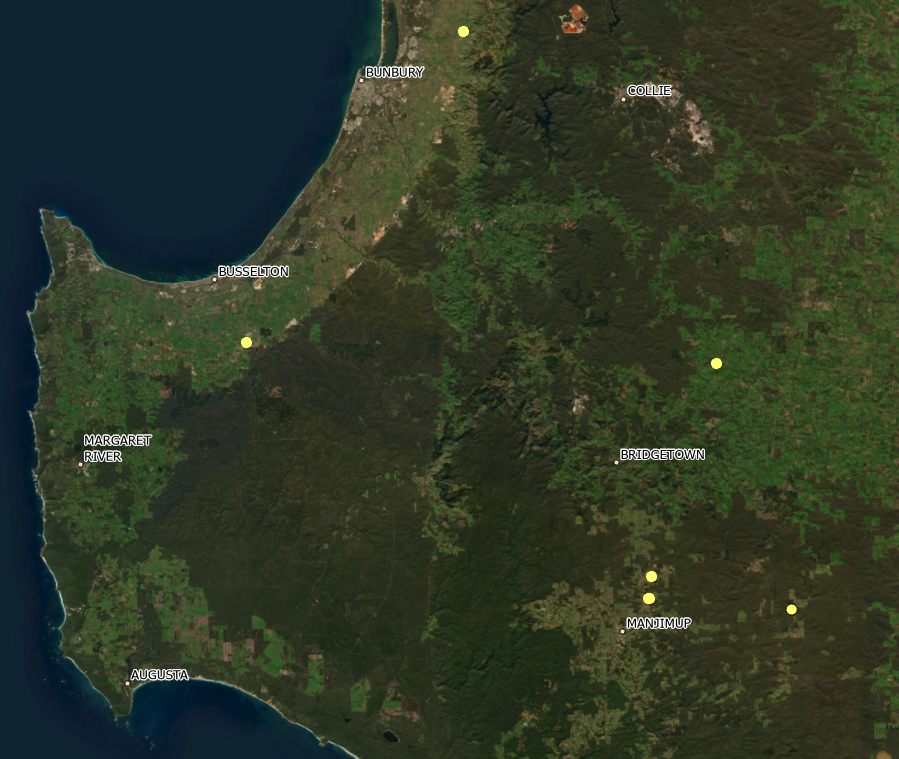
Perennial pastures were typically dominated by perennial ryegrass (four of six sites) or cocksfoot (2 sites) sown as part of South West NRM Climate Smart Agriculture project called FEaST2030. Annual pastures were dominated by annual ryegrass, with some weeds such as wild oats present in November and April samples. Sub clover was also present in November but degrading and difficult to sample. Further details on the perennial pastures and sites are described here (Noting that “Busselton Grower 2” was not included in this study).
Results were provided to cattle nutrition consultant Martin Staines who has completed a report as follows.
Report
Prepared by: Martin Staines – Cattle Nutrition Consultant, Metricup
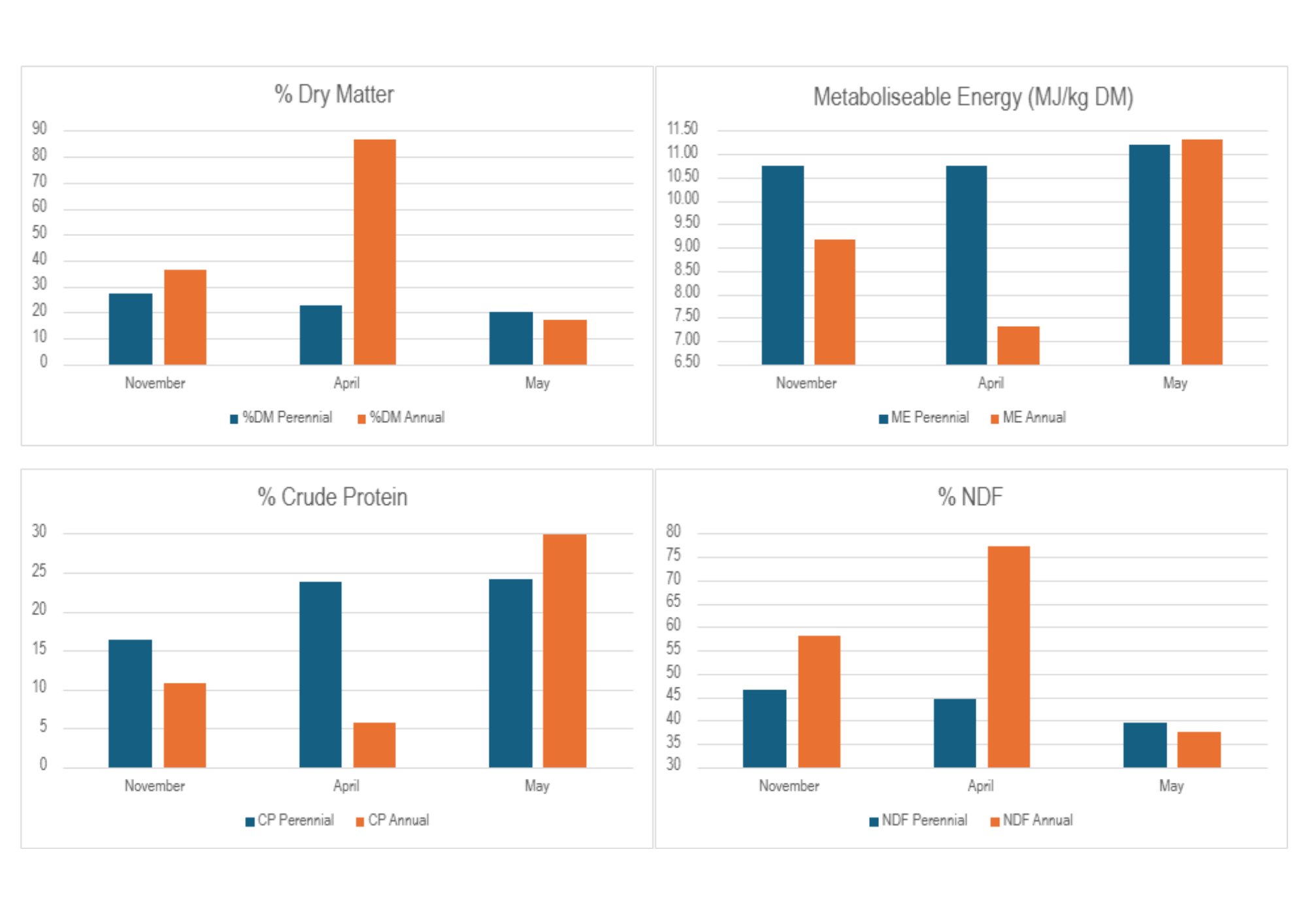
Means for nutritional value of the pastures are summarised in the charts below for dry matter (DM, as %), metabolizable energy (ME in MJ/kg DM), crude protein (CP, as %) and neutral detergent fibre (NDF, as %).
November
This information was used to model the expected performance of beef cattle fed such pastures, for the November, April and May samplings, using the Rumen8 cattle nutrition software (www.rumen8.com.au). Assumptions used and results are given below.
Cattle were 400 kg Angus steers (9 months of age). It was assumed that forages are available ad libitum.
With perennial pasture (ME 10.8, CP 16%, NDF 46%) steers are predicted to consume 9.2 kg DM providing 99 MJ ME, sufficient to achieve a rate of liveweight gain (LWG) of 0.90 kg/day. NDF intake was ~1.1% of live weight (LW).
With annual pasture (ME 9.2, CP 11%, NDF 77%) steers are predicted to consume 9.5 kg DM providing 87 MJ/d, sufficient to achieve a rate of LWG of 0.52 kg/day. However, owing to its high NDF content, NDF intake would be 1.4% of LW which is unlikely to be achieved in practice. If NDF intake from forage is limited to ~1.1% of LW (similar to NDF intake with the perennial pasture) then DM intake would be just 7.4 kg, providing 68 MJ ME, which is sufficient to achieve a LWG of 0.19 kg per head per day.
Results are summarised in the table below, together with the supply of metabolizable protein (MP; as % of requirements) and the expected $ Margin (Beef income minus feed costs).

April
Cattle were 500 kg Angus replacement heifers (1y9m of age; 200 days pregnant). It was assumed that forages are available ad libitum. Note that in practice pasture is unlikely to be available ad libitum at this time of the year on many beef farms, so this exercise serves to illustrate potential only. Note also that although these are pregnant replacement heifers that will not be sold for slaughter, their LW gain nevertheless has an economic value, which is set at $4 per kg LW.
With perennial pasture (ME 10.8, CP 24%, NDF 45%) heifers are predicted to consume 11.4 kg DM providing 123 MJ ME, sufficient to achieve a rate of LWG of 0.94 kg/day. NDF intake was ~1.0% of LW. Supply of MP exceeded requirements by 34% (see comment below on metabolic cost of removing excess MP).
With annual pasture (ME 7.3, CP 6%, NDF 77%) heifers are predicted to consume 7.1 kg DM providing 52 MJ/d, sufficient to achieve a rate of LW gain (LWG) of minus 0.69 kg/day. NDF intake would be 1.1% of LW. However, even this LW loss is unlikely to be achieved in practice as this diet is severely hampered by supply of MP (42% of requirements).
A diet of 50/50 perennial and annual pasture was also modelled. Heifers are predicted to consume 9.0 kg DM providing 81 MJ/d, sufficient to achieve a rate of LW gain (LWG) of 0.14 kg/day. NDF intake would be 1.1% of LW. This rate of LW gain may also not be achieved in practice as this diet is still hampered by supply of MP (87% of requirements).
Results are summarised in the table below, together with the expected $ Margin.

May
Cattle were 500 kg Angus replacement heifers (1y10m of age; 230 days pregnant). It was assumed that forages are available ad libitum.
With perennial pasture (ME 11.2, CP 24%, NDF 40%) heifers are predicted to consume 11.2 kg dry matter (DM) providing 125 MJ ME, sufficient to achieve a rate of liveweight gain (LWG) of 0.94 kg/day. NDF intake was ~0.9% of live weight (LW). Supply of MP exceeded requirements by 23%.
With annual pasture (ME 11.3, CP 30%, NDF 38%) heifers are predicted to consume 11.1 kg DM providing 125 MJ/d, sufficient to achieve a rate of LW gain (LWG) of 0.95 kg/day. NDF intake would be 0.8% of LW. Supply of MP exceeded requirements by 36%.
Results are summarised in the table below, together with the expected $ Margin.
Note: in both cases MP supply exceeds MP requirements significantly, which incurs an energy cost for excreting excess protein in urine, thus reducing actual LWG by an expected ~0.22 kg/d for perennials and ~0.35 kg per day for annual pasture. In that case, margins would be reduced to $1.20 and $0.74 per animal per day respectively for heifers fed perennial and annual pastures.

Conclusion
In this study, at the start of the south west Western Australian dry season (November) and during the transition to the subsequent rainy season (April), perennial pastures outcompeted annual pastures in terms of feed quality, thus enabling greater potential animal production. The extent to which this is realised will depend on the amount of forage that is available per animal. While this is generally not a limiting factor in November, it is very likely to be a limiting factor in April. By May, annual pastures and perennial pastures were comparable in ME content, and predicted animal performance was therefore comparable. However, the lower CP excess in perennial pastures incurred a lower metabolic cost than what can be expected with annual pastures.
Further evaluation of the overall farm-systems impacts of perennial vs annual pastures for dryland beef farms in SW-WA will be required.
Note from South West NRM: There was little difference in quality between perennial ryegrass and perennial cocksfoot dominated pasture samples, although cocksfoot dominated paddocks tended to have higher crude protein at all three times.
South West NRM is the Peel and South West Node of the South-West WA Drought Resilience Adoption and Innovation Hub and receives funding from the Australian Government’s Future Drought Fund.