
One year into the Enhanced Farm Dams Demonstration, results indicate that fencing and revegetation are likely reducing turbidity and improving water palatability, while greenhouse gas emissions have dropped during summer and autumn. Seedling survival has varied widely across three dams due to a range of factors including site preparation, seed quality and site conditions.
With winter planting and reporting finished, it’s time to reflect on progress at our four “Enhancing Farm Dam” demonstration sites. We’ll look at seedling survival, water quality, and how emissions are being affected by fencing and revegetation around farm dams.
Under our FEAST2030 project, South West NRM helped to fence and revegetate three farm dams in 2025 at Capel, Thomson Brook and Sunnyside. A fourth dam at Upper Capel was fenced late in 2025 and revegetated in 2026.
Seedling survival: What worked and what didn’t
Seedling survival surveys in May and June this year showed that the 2025 plantings varied in their success. The Sunnyside site near Bridgetown recording 90% survival, which is incredibly high considering how dry our summer was, with virtually no rain recorded for three months (and no hand watering conducted). Some of the factors behind that success included excellent site preparation (weed control) and seedling quality.
The two other sites averaged 46% survival and were dealing with some significant issues. The Capel dam site has moderately saline soils (5.6 dS/m) and the wet winter meant the coastal plain site was heavily flooded, delaying planting until mid-September and potentially causing some to drown. An intensive weed management program to eliminate kikuyu preceded planting, but sparked the germination of the annual herb, lesser loosestrife, which may have competed with shrubs for water later in the year. In addition to these factors, some plants were also root bound when received from the nursery. This issue can be managed by ordering plants in October or November to increase the likelihood that your seedlings will be a higher quality.
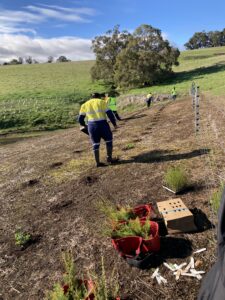
Revegetation in progress at the Thomson Brook site in 2025.
The Thomson Brook site varied in success with the western side having 74% survival while the eastern side had 27% survival. Possible reasons include the impact of the late afternoon summer sun hitting the eastern side, compacted soil on the eastern side, or weed load.
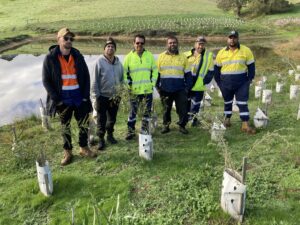
At the Thomson Brook project site, Keipa Boodja Director, Murray Collard (second from left) joined the Danju – Jobs Together team of Laurie Winmar, Shannan Turvey, Peter Jetta, Scott Bazeley and Boston Turvey beside revegetation established in June 2025.
Survival rates mean that of the initial 7,882 seedlings planted on a total of two hectares in 2025, approximately 4,666 survived. To make up for these expected losses, infill planting took place on each dam in June 2026, with an additional 1,415 seedlings being planted.
Birds and frogs return to revegetated dams
The hard work by Landcare groups and farmers involved in revegetation and weed control is starting to show dividends with small woodland birds now using the revegetation. Birds and frogs were monitored in November 2025 through a collaboration with GGA’s Ripple Effect project, and a follow up survey is planned for November 2026.
Water quality showing positive signs
Monitoring of water quality has been ongoing at all four sites and has started to show some interesting trends.
The site in Upper Capel has shown a significant reduction in iron and aluminium, and similar trends were seen at two other dams. These dams have a relatively neutral pH, so it is unlikely that the elements are biologically available and are instead attached to clays suspended in the water. So, the reduction suggests less solid particles suspended in the water, which can reduce turbidity. Turbid waters are less palatable for stock, reducing the amount they want to drink and subsequently also limits feed intake. Turbidity can also reduce aquatic flora and fauna.
Greenhouse gas emissions drop in warmer months
South West NRM has been collaborating with RMIT under the Ripple Effect project to monitor changes in greenhouse gas emissions following enhancement of farm dams.
So far, RMIT has seen some notable reductions in methane emissions at fenced compared to unfenced dams at two of the three properties during the late summer and autumn months, but those differences largely disappeared during the winter months.
For nitrous oxide (N2O), the pattern is similar, with reductions occurring in the summer and autumn months across all three sites, but again, largely disappear during the winter months.
Planning and preparation are key
Results suggest that enhancing farm dams is benefiting livestock and reducing farm emissions, but good planning and preparation of revegetation is required with an expectation of infill planting and ongoing management in the following years.
South West NRM will continue monitoring for the next two years to demonstrate the benefits of enhancing farm dams.
South West NRM’s FEaST2030 project is supported by the Australian Government through funding from the Natural Heritage Trust under the Climate-Smart Agriculture Program.
Want to know more about enhancing farm dams?
Explore our three-part series covering the benefits and costs, planning and implementation, and long-term management of enhanced farm dams.