Another step towards a future for the critically endangered hairy marron
Home » Another step towards a future for the critically endangered hairy marron
Twelve critically endangered hairy marron (Cherax tenuimanus) have been translocated to a specially prepared site in the Margaret River region for a nine-month trial, marking the latest stage in a project delivered via a partnership between South West NRM and the Department of Biodiversity, Conservation and Attractions (DBCA).
The hairy marron bred through a collaboration between Perth Zoo’s Native Species Breeding Program and DPIRD’s Pemberton Freshwater Research Centre, arrived on-site in September 2026, where they were placed in specialised enclosures for close monitoring over the coming nine months. The trial is another carefully controlled step towards determining whether the location could ultimately support a future wild population of hairy marron.
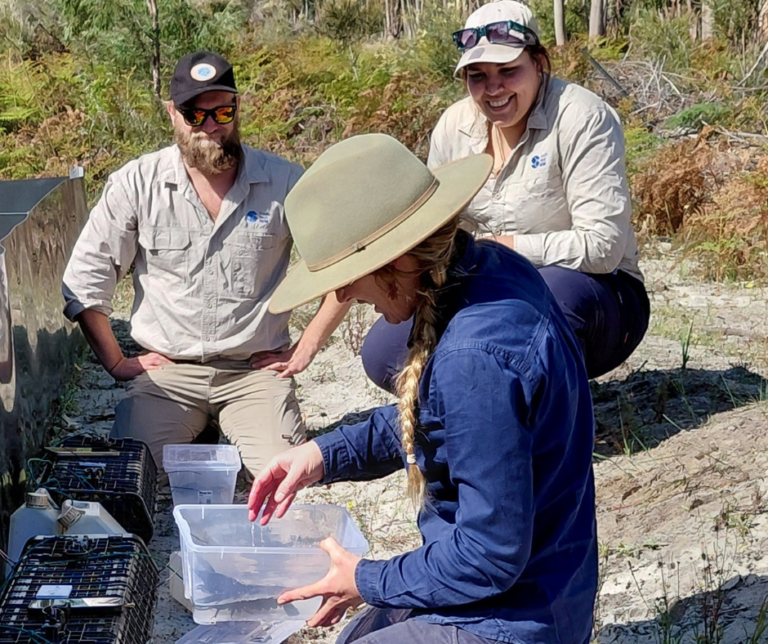
DBCA’s Peta Lierich (front) with South West NRM’s Tom Andrews and Jade Riley in the background, preparing for the translocation of 12 critically endangered hairy marron to the trial site.
Getting to this point has involved extensive site assessment, water-quality monitoring, threat reduction, habitat preparation and carefully staged trials, reflecting the complexity of trying to establish a new population of a species at risk of extinction.
This latest stage forms part of South West NRM’s Protecting Critically Endangered Crustaceans in the South West project, running from 2024 to 2028 and delivered in partnership with DBCA, Perth Zoo, Nature Conservation Margaret River Region and Karri Karrak Aboriginal Corporation.
Small species, rapidly declining
Wild populations of the critically endangered hairy marron now persist in very small numbers in the Margaret River. Monitoring surveys in 2026 sampled over 1200 crayfish with only three being confirmed as genetically pure hairy marron.
The most significant threat to the species is hybridisation with smooth marron (Cherax cainii). Since smooth marron were introduced into the Margaret River, interbreeding has created hybrid populations, reducing the number of genetically pure hairy marron.
Hairy marron can also be difficult to distinguish from smooth marron and hybrids, particularly when they are juveniles, making them vulnerable to fishing.
Invertebrates like marron may not always attract the conservation attention of larger or more visible species, but they play important roles in healthy ecosystems. Marron are important recyclers in freshwater ecosystems, breaking down living, dead and decaying plant and animal matter.
Alongside efforts to establish a new population, South West NRM is working with Nature Conservation Margaret River Region (NCMRR) to investigate whether hairy marron may survive in other locations. Using environmental DNA (eDNA) sampling on private properties, the work aims to identify previously unknown populations of the species. One sample has detected DNA from both hairy and smooth marron, although further investigation is needed to determine whether this indicates the presence of genetically pure hairy marron or hybrids.
With its highly restricted natural distribution and the ongoing threat from hybridisation, establishing a healthy population of hairy marron at a secure location is an important conservation strategy.
The search for a future home for hairy marron
The translocation builds on more than two decades of recovery efforts by DPIRD, DBCA, Perth Zoo and NCMRR to conserve one of Western Australia’s most threatened freshwater species. As part of these ongoing efforts, the search for a suitable location to translocate hairy marron began in 2021, with potential sites assessed by DBCA for their suitability for long-term conservation value, water reliability and quality, predator risk and the presence of smooth marron.
Two sites were investigated in detail however a second was discounted when drought in 2023-2024 exposed concerns about its long-term viability, with much of the wetland drying and changes in water temperature and acidity.
Preparing a protected new home for hairy marron
To remove the threat of hybridisation with smooth marron, the translocation site was completely dewatered allowing accumulated sludge and organic material to be removed and the area to be thoroughly surveyed. A total of 241 freshwater crayfish including smooth marron were captured and removed.
eDNA sampling provided another tool for monitoring the smooth marron threat. Water samples taken before and after the works established baseline information to support ongoing surveillance for smooth marron.
A suite of physical and chemical water quality parameters have been monitored throughout the work helping build the knowledge required to assess the ongoing suitability of the site for hairy marron.
Enhancing habitat and reducing risk
Site preparation highlighted the need to secure the area against smooth marron reinvasion and natural predators, while enhancing in-stream habitat to provide safe refuge for hairy marron.
A range of habitat structures are planned for a future free-swimming stage, including complex PVC structures, marron hides and large woody debris designed to mimic natural habitat features. By increasing habitat complexity, these structures will provide refuge from predators, reduce competition and aggression between individuals, and encourage the growth of algae as a potential food source.
The project team worked with Karri Karrak Aboriginal Rangers to construct the habitat structures.
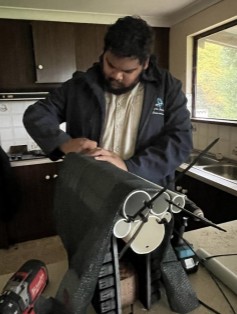
Karri Karrak Ranger Lyle Corpus arranges pipes and interwoven shade cloth to create artificial habitat structures for hairy marron at the site
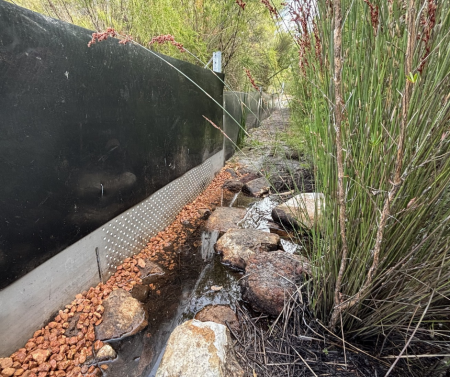
250 metres of specialised exclusion fencing was installed at the site, along with a purpose-built outflow barrier. Together, these measures are designed to reduce the risk of smooth marron returning and help contain hairy marron within the site.
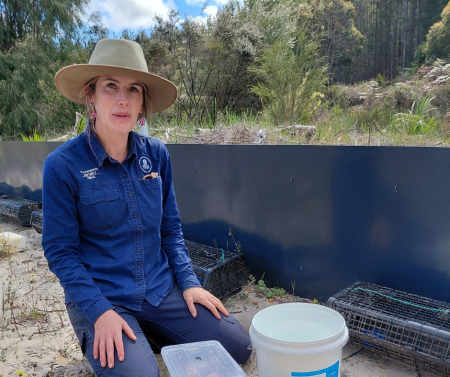
DBCA’s Peta Lierich alongside specialised exclusion fencing designed to prevent smooth marron from returning to the dam and help keep predators out of the trial site.
Karri Karrak Rangers assisted with the fence installation.
The measures cannot eliminate every risk, so trapping, surveillance and water-quality monitoring remain part of ongoing site management.
A staged approach to trialling hairy marron
With the site prepared, the project moved into controlled trials.
The first phase used hybrid hairy-smooth marron, allowing the team to test conditions at the translocation site. Eighteen hybrids were placed in specialised in-water enclosures suspended, where their survival, growth and condition could be closely monitored.
The latest trial
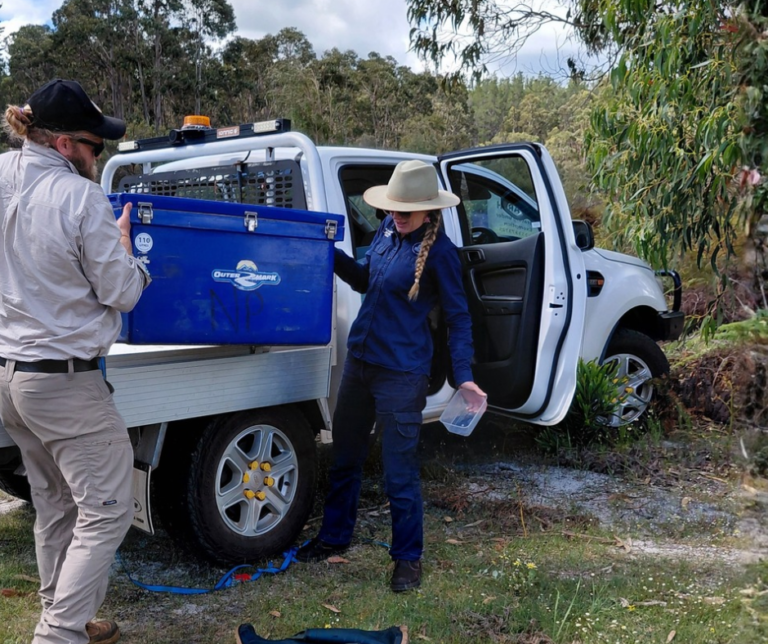
Precious cargo: DBCA’s Peta Lierich and South West NRM’s Tom Andrews carry an esky containing critically endangered hairy marron from the vehicle to the release site ahead of their nine-month trial.
The 12 hairy marron now in place were selected by the Perth Zoo team in collaboration with DBCA and DPIRD Pemberton Freshwater Research Centre staff, taking into account their parentage and relatedness, their value to the breeding program and genetic representation for a potential future population.
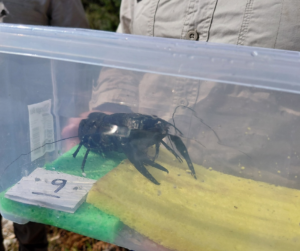
Hairy marron were transported individually with damp sponges and a small amount of water to help maintain suitable conditions during the journey.
All 12 were transported, treated and placed into their enclosures. Over the next nine months, they will be monitored weekly for health and condition, moulting (shedding its exoskeleton), behaviour and signs of disease.
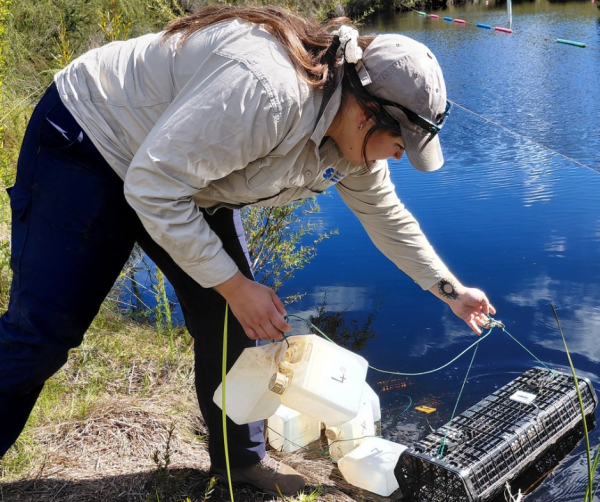
One of the 12 hairy marron, secured in its enclosure, being lowered into the water for the nine-month trial.
What happens after that will depend on the evidence gathered through this and the preceding trials. If the results support taking the next step, the project could ultimately progress to a free-swimming population of hairy marron.
For a species found nowhere else in the world, this latest translocation is another carefully managed step towards a more secure future for hairy marron in the wild.
Find out more about South West NRM’s Protecting Critically Endangered Crustaceans in the South West project.
This project is funded by the Australian Government’s Natural Heritage Trust and delivered by South West NRM, a member of the Commonwealth Regional Delivery Partners panelin partnership with the Department of Biodiversity, Conservation and Attractions (DBCA).