
Living Firebreaks Project Update May, 2026
Two unassuming native shrubs in your garden may be quiet heroes, identified by WA fire researchers as powerful allies in mitigating the impact of bushfire on farms and communities.
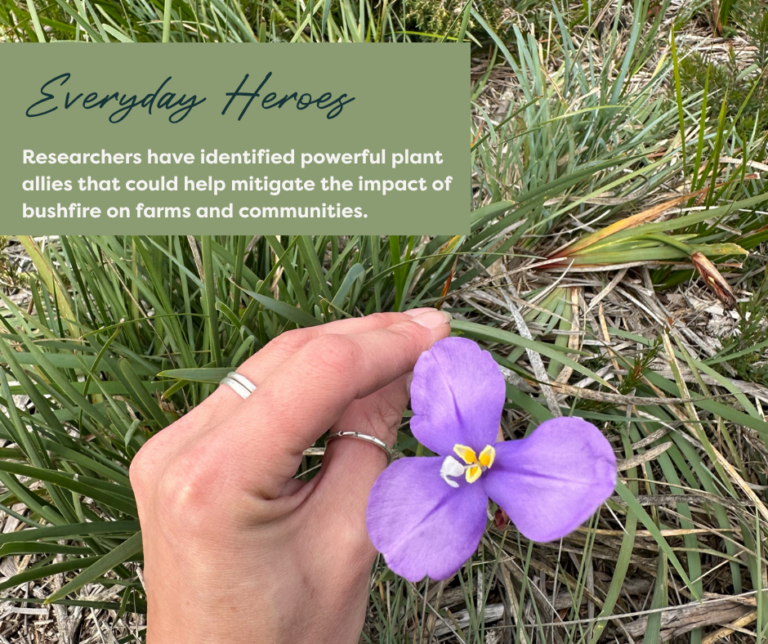
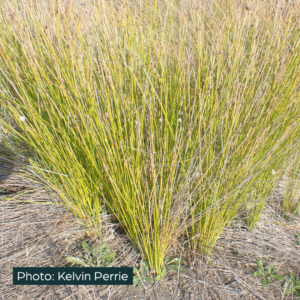
The Native Iris or Purple Flag and the Knotted Club-rush are two of 99 WA native plants found to have traits that could reduce the intensity of bushfire behaviour.
Native Iris/Purple Flag (Patersonia occidentalis)
Knotted Club-rush brush (Ficinia nodosa)
The list of plants was identified during a study by Murdoch University researchers, carried out as part of our landmark Living Firebreaks trial.
Both the Native Iris and Knotted Club-rush are among the 6,000 seedlings we’ve just ordered, ready for a mass winter planting across four Living Firebreaks we’re installing on farm trial sites in Boyup Brook, Quininnup, Balingup and Narrogin.
But before you go filling your garden with these guys, it’s worth understanding more about the science behind the design of our Living Firebreaks.
Read on for a project update and more of the 99 approved plants on our list…
Project Update
We’re testing whether a Living Firebreak can both mitigate the potential impacts of bushfire on farms and communities, while delivering positive biodiversity outcomes for the surrounding environment.
Researchers at Murdoch University identified a list of suitable plant species based on their low-flammability likelihood, as determined by plant traits known to influence fire behaviour. This mainly came down to plants that have a short height and low amounts of woody material.
Because many of the species on the list weren’t commercially available, we had to compromise – choosing species that fit most of the requirements for what may make a plant less flammable. Our key interest here is assessing, through field experiments with Murdoch University, which of these traits are most influential on impacting fire behaviour.
But among other seedlings included in our bulk order are names you might also recognise such as:
Blue lechenaultia (Lechenaultia biloba)
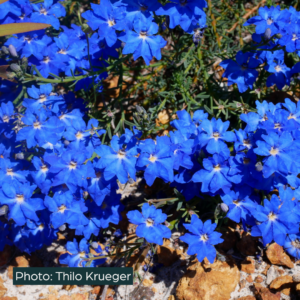
Running Postman (Kennedia prostrata)
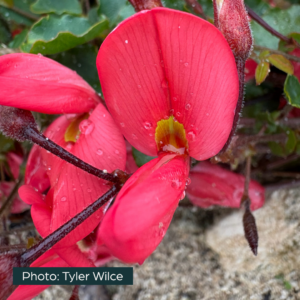
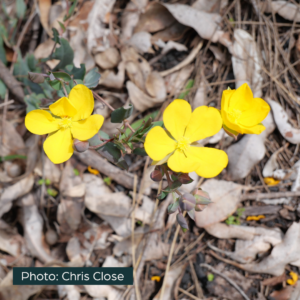
Hibbertia amplexicaulis
We’re hoping winter rainfall will kickstart growth of our little seedlings which have all been carefully selected because they are:
- Native to Western Australia;
- Identified as having traits with the potential to reduce fire intensity, according to research by project partners Murdoch University;
AND…
- Grow to around 1.5m in height.
Surprised? You might imagine a Living Firebreak as a big row of trees.
As well as our friends at Murdoch University, the design and structure of our Living Firebreaks has also been informed by previous findings from the University of Melbourne’s FLARE team – one of Australia’s biggest fire research groups.
Research teams from both universities used sophisticated fire simulation software to test various firebreak designs and approaches.
Another project criterion that each of our chosen seedlings had to meet was they must contribute to positive outcomes for local biodiversity.
That means they needed to be attractive to pollinators like bees or provide habitat for native animals.
We know! It was a big ask of one little plant. And of the researchers as well, to find a list of plants that could meet these requirements.
Once we had our list of preferred plants, it was a matter of identifying which plants were most suitable to each location and which ones were currently available through nurseries.
Big thanks to native plant nurseries for helping with our orders:
- Leschenault Community Nursery
- Boyanup Botanical Nursery
- Blackwood Environment Society Landcare Nursery
- Geographe Community Landcare Nursery
Stay tuned for further updates as we await the arrival of our seedlings, commence planting at each of our locations AND invite YOU to help build resilience to bushfire in our community by contributing to research outcomes of this project.
The Living Firebreaks project is delivered in collaboration with NRM Regions Australia with the support of the Minderoo Foundation as part of an ongoing national program to improve awareness, capability, and investment for nature-based solutions that can deliver broad benefits across Australia.