
Floating greenhouse gas sensors and an electronic ‘moth’ for remote activated listening. Welcome to the cutting-edge science of emissions reduction and biodiversity enhancement.
Both have been deployed in a project South West NRM launched last year designed to test strategies that could simultaneously make farm dams more environmentally friendly AND more valuable to producers.
Background
When it comes to Australia’s national efforts to reduce emissions, the humble farm dam has come under particular focus.
Research back in 2018 identified farm dams without fencing or bank vegetation as significant contributors to greenhouse gas emissions – especially methane (Ollivier et al. 2018).
But our drying climate is also pushing up the number of dams being installed as farmers seek to ensure they have enough water for their stock or to irrigate crops through long, hot summers.
The result is a vicious circle of ever-increasing dam emissions that has caught the attention of researchers and those involved in helping encourage more sustainable approaches to agriculture that can benefit both farmers and the environment, like South West NRM.
The Project
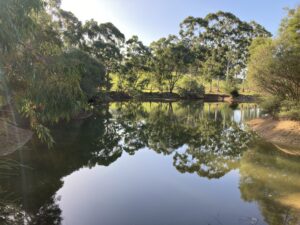
An enhanced farm dam.
Enhancing farm dams by fencing them off from livestock and revegetating their banks has gained attention as an approach for both improving water quality, reducing emissions and enhancing biodiversity by creating fresh habitat for insects, birds and frogs. Installation of solar-powered troughs have provided water to livestock.
With funding support from the Australian Government’s Climate-Smart Agriculture Program, South West NRM is testing the approach as part of our Farm Efficiencies and Sustainability Towards (FEaST) 2030 project.
Four farmers with properties located across the South West have put their hands up to participate by working with us to fence and revegetate their dams.
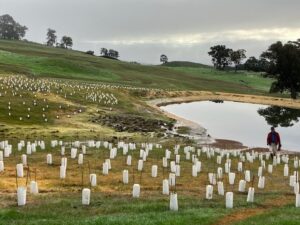
Revegetation of a farm dam involved in the FEaST Project.
The Technology
We’ve expanded the original scope of our FEaST 2030 project by partnering with researchers involved in The Ripple Effect project to test their technology and add information to their own studies on enhancing farm dams.
Pondi Sensor
A floating greenhouse gas sensor, called a Pondi, developed by researchers at Deakin’s Blue Carbon Lab (Dr Martino Malerba now at RMIT and working with us on this project along with his colleague Lukas Schuster) in collaboration with the University of Queensland (Dr Alistair Grinham) and LeadingEdge Engineering (Blake Edwards).
Installed at each of our four dams, the Pondis are providing real-time data on emissions levels and will be tracked and monitored across the life of the project.
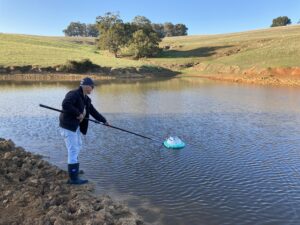
South West NRM Program Manager Sustainable Agriculture Peter Clifton positioning a Pondi.
Our pondis are already providing some early data.
Lukas from RMIT said: “It’s still early days, but we are seeing some interesting trends at our Bridgetown site. There is an indication that methane and nitrous oxide fluxes spike as cows enter the water to cool off in early summer (as expected), so there is an early treatment effect there. But we’ll need more data to see long-term effects.”
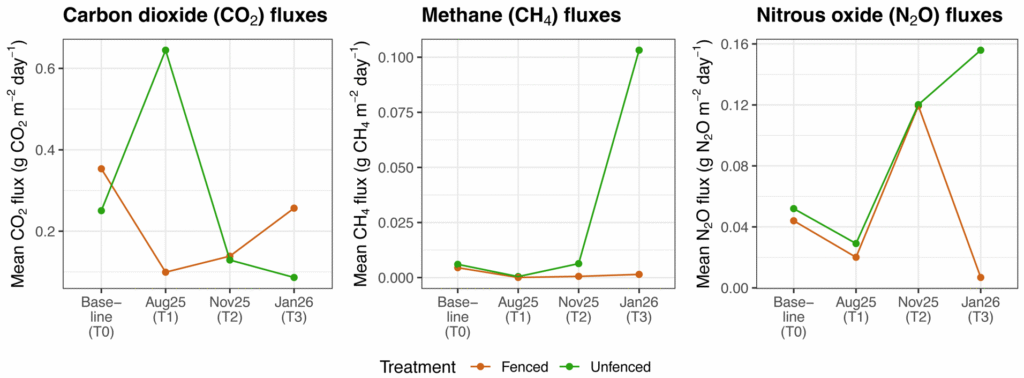
This and more will be discussed at our upcoming event at the Bridgetown dam on 26 March.
Contact Karrie Williamson on nrmbridgetown@gmail.com for more information.
Audiomoth
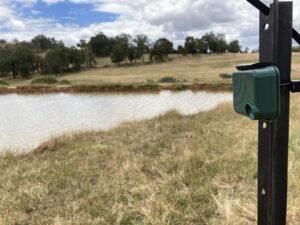
In the same way that moths are capable of hearing high frequency sounds well beyond the capability of human ears, the AudioMoth is a credit card-sized, remote-activated device which records high frequency sounds in the environment – known as environmental acoustics.
The little devices measure biological activity levels in the environment, and we’ll be comparing recordings from our revegetated dams with those captured at control sites where no plantings have occurred. The recordings will also be monitored over the life of the project to detect change in biological activity.
AudioMoths were provided by the Australian National University through The Ripple Effect project.
In conclusion
South West NRM, with its partners, works at the intersection of science, technology and landcare, across natural and agricultural landscapes. We deliver evidence-based solutions for creating healthy ecosystems as well as improved productivity and sustainability for farmers.
Stay tuned for further updates as this project develops.
FEaST 2030 and The Ripple Effect Projects are supported by the Australian Government through funding from the Natural Heritage Trust under the Climate-Smart Agriculture Program.