
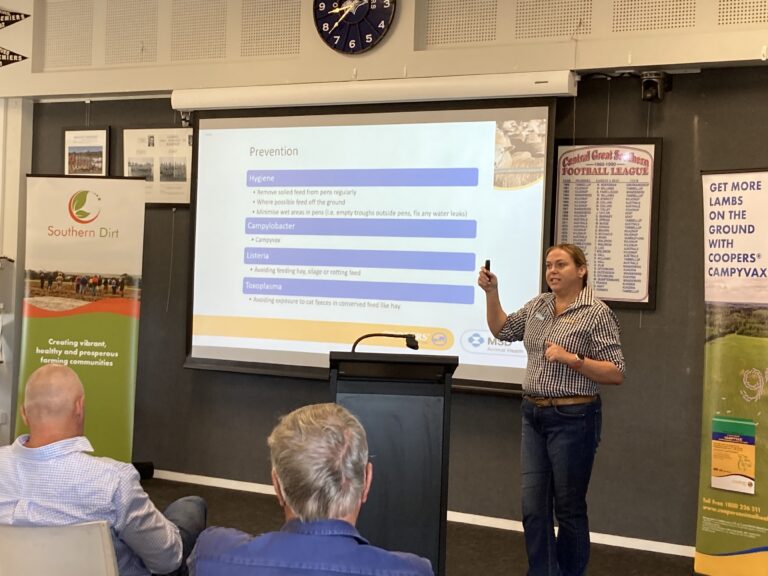
Animal health consultant Felicity Wells shares her knowledge.
Confinement feeding for 4-5 weeks at the break of season can be a win-win for sheep producers. Not only can they increase stocking rates and lamb survival, but they can also reduce fuel bills, maintain ground cover, allow pastures to establish and thrive, and reduce soil (and nutrient) erosion.
But if it’s not done well, it can be a loss-loss! So close consideration of design, nutrition and hygiene is critical.
To help producers understand and mitigate risks, grower group Southern Dirt Inc invited Coopers Animal Health consultant Felicity Wills to their recent Sheep Nutrition workshop in Kojonup to outline the key considerations. Felicity started by talking about design.
Design considerations
A common question Felicity gets is around mob size and space.
“I can’t find anywhere in the literature that gives an optimum mob size for joining and feeding pregnant ewes in confinement,” she said.
“I’ve seen big mobs managed well, over 700 ewes per pen, depending on space and design. Although smaller mobs can be easier to manage.
“The bigger the mob size, the harder it is to observe each individual, so the harder it is to pick up something that’s going wrong. And bigger mob sizes can increase the risk of shy feeders if we don’t have enough feed space available.
“In terms of space, we want to get them confined enough that they’re not walking around consuming energy, and we want stocking density high enough that dust levels are down, but they also need enough space to function as a ruminating sheep and to minimise the risk of contamination and animal health concerns.”
Dust is not only an issue for things like pinkeye and pneumonia, but it can also reduce water quality and intake, which is another key consideration.
Thinking about water
Felicity went on to say:
“Having a good idea of your water quality and water source and how you will manage water quality is really important. Without good water they won’t eat, and they won’t perform.”
You need to make sure water is clean, feeders are filled, and animals are healthy, which means monitoring is vital.
“You need to take time to check animals each day. Have we got animals chewing their cud and walking to troughs, or do we have animals not interested in feeding? Have a look at their poo. Once we start seeing diarrhoea, we need to start thinking what’s going on.
“Monitoring is really important particularly early in the feeding period, so picking out your shy feeders and maybe putting them into a small pen by themselves or into a paddock with some supplementary feed.
“It’s good to have a hospital pen or paddock, so if anything’s not doing well, whether it be not-eating, pneumonia etc, you have somewhere that they can get moved to help them recover and reduce the risk of spread of disease in the feeding pens.”
The case for separation
Felicity suggested a good way to reduce competition for feed and feeding space, and the risk of shy feeders is to separate animals into different pens based on body condition, size and breed.
Another factor to separate animals on is their different energy requirements. This means separating ewes bearing singles, twins and triplets, which will have different energy requirements later in pregnancy, and means scanning can be important.
While the energy requirements of pregnant ewes is higher than for dry ewes, this doesn’t mean we can forget about roughage. But selecting the best source should be considered.
“Always have at least 10% of the diet made up of roughage. But if the quality of roughage is too high, they may eat too much roughage and not enough higher concentrated feed to meet demands, so you may need to change the source of roughage late in pregnancy,” she said.
Nutrition of pregnant ewes is too important to simply base on feed budgeting tables, so must be complemented with condition scoring.
“Monitoring body condition is really important when you’re feeding over the pregnancy period to ensure diets are adequate, especially when sheep have a lot of wool,” she said.
As pregnancy progresses and energy demands increase, the introduction of higher energy feeds, grain and even some pellets must be done slowly and with consideration of acidosis.
Other considerations
Likewise, transition from confinement into the paddock must also consider feed quality. Because lambing is not recommended in confinement, transition will need to occur about 3-4 weeks prior to lambing, especially for twins and triplets, as energy requirements are still rising.
Felicity said: “As you get them back into the paddock, they generally need supplementary feeding in the transition. I’ve seen where ewes have been put on a good-looking pasture but it’s not meeting their nutritional requirements.”
And of course, transition isn’t only important after confinement feeding, it’s also critical before putting animals into confinement.
Nutritional stress and environmental stress is one of several factors behind the increased risk of disease in confinement. Contamination is another.
“Nutritional and social stresses reduce natural immunity to disease, so reducing contamination is vital in confinement,” she said.
“We tend to see higher faecal contamination and more exposure to pathogens when we feed closer to the ground in high stocking densities. And one outcome of this is cases of infectious abortion. For example, campylobacter, listeria, toxoplasma and salmonella.
“We need to manage feeding well to manage hygiene levels. Removing soiled feed from pens regularly is important, and we often see issues like listeria where roughage is fed and builds up on the ground. My preference is to feed off the ground where possible, so in hay feeders. Trail-feeding can be done well, but you’ve got an increased risk feeding on the ground in confinement.”
Some growers use a skip pen system where they feed every second day into an empty pen, then move animals into that pen, giving them then chance to clean out the original pen before moving animals into it.
“And the other main factor is reducing wet areas. Wet areas in pens are where we tend to see issues start. We need to clean waters every day or second day, but my preference is to not tip them out in the pen (one option may be to have water at the downslope point of pens).
“Aborted material is a huge source of contamination of campylobacter so removing that material is critical and where possible removing animals that have aborted from the pen.
“In Australia Campylobacter is the most common infectious cause of abortions in ewes and luckily, we have a vaccine that can protect against losses, Coopers® Ovilis Campyvax. Given that feeding pregnant ewes in confinement can increase the risk of campylobacter spread and abortions, you should consider vaccination before feeding pregnant ewes in confinement.”
More information
The WA woolgrower’s guide to containment feeding
http://www.lifetimewool.com.au/toolsmgt.html
Ovilis Campyvax | Campylobacter Vaccine For Sheep | Coopers
This event was part of South West NRM’s FEaST2030 project, supported by the Australian Government through funding from the Natural Heritage Trust under the Climate Smart Agriculture Program.
The FEaST2030 project includes a focus on feed efficiencies to increase productivity and reduce greenhouse gas emissions.