
Perennial Pasture Demonstration Update – December 2025
There’s been a lot of learnings already from our seven perennial pasture demonstration sites. Pasture composition surveys over the past month have created discussion around seeding rates, weed control, depth of seeding and whether to sow in autumn/winter or spring.
While some growers are wary of sowing in late autumn/winter when temperatures drop and plant growth slows, the alternative of waiting until spring has its own risks. That has played out this year with high rainfall leading to waterlogging, delaying weed control and sowing.
Two demonstration sites on the coastal plain chose to sow in spring, but the wet winter meant paddocks could be sown until October, a month later than planned. Since sowing, the sites have had 92 and 59 mm of rainfall respectively, resulting in patchy germination and significant bare soil heading into summer. In retrospect, pivoting to a summer crop may have been a better option, although one grower can irrigate.
Similarly, two sites that sowed in early to mid winter have seen slow growth, the latter also having significant areas of bare soil, although both sites received 39-52 mm of rainfall since being surveyed.
For the other three farms, survey results were much better, achieving about 75% perennial pasture cover and already getting plenty of grazing days. And these three also happen to be the three sown earliest. Admittedly, one used irrigation for two weeks before the season broke in early April, while the other two sowed in May.
But of course, sowing in autumn may leave less time for “weed” control, including the control of annual ryegrass, probably the toughest competitor for perennial pastures.
To account for that, two sites were sown into paddocks after a vegetable rotation where weed pressure was low. Another site began control in 2024 by spraying out clover and ryegrass in spring and planting a summer crop (sorghum).
But these options aren’t available for all growers.
So what other tools are there?
Barenbrug’s Tim O’Dea suggests a two-year weed control program can start in spring of year one by spray topping the annual grasses and weeds (a sublethal application of herbicide when grasses come into head to reduce seed viability). This is an alternative to a complete knock-down and sowing a summer crop. In year two, a double knock of annual grasses can be followed with an oats or a brassica crop. Then year three has a final knock down before sowing perennials.
Good planning to allow for early weed control and sowing has been critical so far, as shown by pasture survey results shown below:
MANJIMUP GROWER 1
Soil type – gravelly loamy sand with extremely high PBI and soil pH of 6.2 (CaCl2).
Pre-sowing weed control – Chose to follow a brassica vegetable rotation where weed pressure was reduced. One knock-down spray in March 2025.
Sowing date – 25 March 2025 with:
- 4Front Ryegrass at 10 kg/ha.
- Holdfast Phalaris at 10 kg/ha.
- Kainui Cocksfoot at 10 kg/ha.
In-season management:
- Irrigated for two weeks prior to break on 5 April
- Weeds – treated broadleaf weeds.
- Fertiliser – applied sulphate of ammonium at 75 kg/ha.
- Grazing – 9 days, typically 1 day per rotation, totalling 2,388 ewe/lamb grazing days per hectare (number of ewes and lambs x number of days grazed).
- Locked up from 17 September for seed production.
Pasture composition (percent cover) surveyed 1 December 2025:
- Perennial grass – 90%.
- Annual pasture (e.g. ryegrass) – 5%.
- Weeds (e.g. barley grass) – 5%.
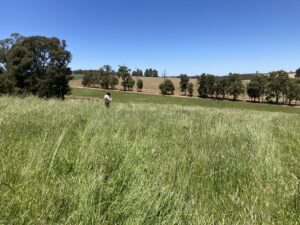
This pasture is being allowed to go to seed.
BUSSELTON GROWER 1
Soil type – Sand with very low PBI, some waterlogging and soil pH of 5.5.
Pre-sowing weed control – one knockdown spray (10 April), following by mouldboard ploughing to 30 cm and power harrow on 22 April.
Sowing date – 4 May 2025 following 25 mm of rain on 2 May with:
- Samurye ryegrass at 30 kg/ha (Hybrid – 50% perennial (Bealey), 50% annual (Italian)
- Haifa White Clover at 3 kg/ha.
In-season management:
- Grazing – after one light graze, has grazed dairy cows for 12 hours once per month, totalling 353 dairy cow grazing days per hectare (number of dairy cows x number of days grazed).
- Fertiliser – follows each graze with Urea S at 90 kg/ha.
Pasture composition (percent cover) surveyed 26 November 2025:
- Perennial grass – 73%.
- Perennial clover – 0%.
- Annual pasture (e.g. ryegrass) – 10%.
- Weeds (e.g. barley grass) – 15%.
- Bare ground – 2%.
MANJIMUP GROWER 2
Soil type – gravelly loamy sand with extremely high PBI and soil pH of 4.8.
Pre-sowing weed control – chose to plant a paddock following a potato rotation where weed pressure was reduced. Sprayed non-selective herbicide in May 2025 after potato harvest and levelling.
Sowing date – 28 May 2025 with:
- Abergreen ryegrass at 15.6 kg/ha.
- Abergain ryegrass at 15.6 kg/ha
- Chicory at 2 kg/ha.
- Howlong Cocksfoot at 3.8 kg/ha.
- Holdfast Phalaris at 3 kg/ha.
- Barenbrug southwest perennial mix (48% hybrid ryegrass 20% perennial grass, 26% annual clover, 6% white clover) – applied on 11% of paddock.
In-season management:
- Weed control – sprayed broadleaved weeds in mid-October after chicory was established, but reduced chicory cover.
- Fertiliser – two foliar sprays and N-P-K-S fertiliser applied at 100 kg/ha.
- Grazing – 35 days in late spring, 1,277 ewe/lamb grazing days per hectare (number of ewes and lambs x number of days grazed).
Pasture composition (percent cover) surveyed 1 December 2025:
- Perennial grass – 87%.
- Perennial clover – <1%.
- Chicory – <1%.
- Annual pasture (e.g. ryegrass) – <1%.
- Weeds – 1%.
- Bare ground – 11%.
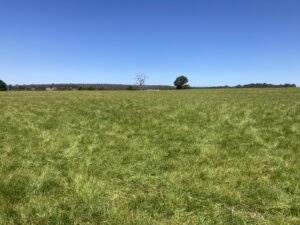
This site received 62mm about a week later.
OTHER SITES
These sites have had less in-season management, with two sown in winter being grazed lightly twice in spring and fertiliser or foliar sprays applied. Average pasture composition for these sites are:
Winter sowing (note these sites have received up to 52 mm since being surveyed):
- Perennial cover – 17%.
- Annual pasture (e.g. ryegrass) – 12%
- Weeds – 12%.
- Bare ground (mainly between seeding rows) – 59%.
Spring sowing:
- Perennial grass – 4%.
- Annual pasture (e.g. ryegrass) – 5%.
- Weeds (e.g. cape weed)– 20%.
- Bare ground – 72%
This demonstration forms part of the FEaST Project which is supported by the Australian Government through funding from the Natural Heritage Trust under the Climate-Smart Agriculture Program and delivered by South West NRM, a member of the Commonwealth Regional Delivery Partners panel.