
What does healthy soil biology look like?
At a two-day Soil Biology Masterclass held at UWA in September 2026, one message emerged repeatedly about what healthy soil biology looks like: context matters.
A healthy sandy soil will look different to a healthy loam. The plants growing in it, seasonal conditions and management history all influence which organisms are present and what they are doing. More biomass of a particular organism, or a higher biological test result, does not automatically mean a healthier or more productive soil.
South West NRM Sustainable Agriculture Facilitator, Amelia Thornton attended the masterclass to explore how this knowledge can support practical decisions on farm. A central message was that soil biology needs to be understood alongside the soil’s physical and chemical characteristics, and the needs of the farming business.
Understanding the function
Soil organisms contribute to processes including organic matter breakdown, nutrient cycling and disease suppression. Mycorrhizal fungi can help plants access nutrients and water, while their fine networks contribute to soil aggregation.
These relationships are complex. Microbes breaking down crop residues can temporarily tie up nitrogen, with the outcome influenced by residue composition and growing conditions. This helps explain why the same management practice can produce different results between paddocks or seasons.
The useful question is: what function are we trying to improve, and what is limiting it in this system?
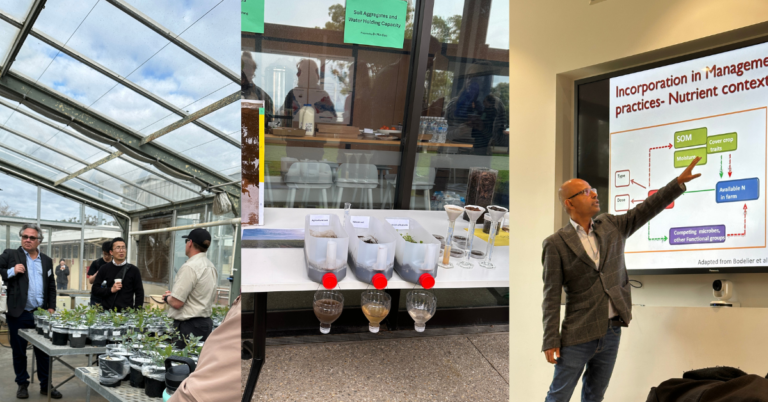
Learning in action at the two-day Soil Biology Masterclass held at UWA in September 2026.
Looking beyond yield
Better soil function may deliver benefits through improved input efficiency or more consistent production. Those benefits need to be measured alongside the cost of achieving them.
Comparing gross margins can help identify whether a change improves returns through higher income, lower variable costs, or both. Other considerations include changes to labour requirements, equipment, financial risk and whether a practice fits the wider business.
Supporting soil biology needs to be economically viable and manageable within existing operations. The starting point will differ depending on the farm’s soils, resources and what the producer is willing to trial.
Observation has value
Farmer Stuart McAlpine shared experiences from his Buntine property, highlighting the importance of digging beneath plants, inspecting roots and comparing changes over time.
A repeated paddock observation can raise a worthwhile question even when the explanation is not yet clear. It provides a starting point for a controlled trial, where two or more areas are compared, and the only difference between the areas is the treatment (other factors that may have caused the result are the same). This approach helps establish whether a treatment caused the difference and whether the result is repeatable.
A controlled trial compares a treatment to an untreated area to build confidence in a practice before committing more widely.
Measure what matters
Comparing treated and untreated areas requires a measure such as a soil biology test. Before choosing a test, consider what change you need to see to support your decision to adopt or not. Sampling location, timing, crop and soil conditions all affect interpretation. A useful monitoring approach establishes a baseline and tracks relevant measures consistently over time.
Measures might include root development, soil structure, disease levels or nutrient inputs, alongside production and costs.
The Masterclass reinforced the value of curiosity, careful observation and shared learning. Improving soil biology starts with understanding your own system and identifying realistic opportunities within it.
If there are soil biology questions you would like explored through local trials, workshops or farmer discussions, or help setting up a controlled trial, get in touch with South West NRM’s Sustainable Agriculture Facilitator. Your interests can help shape future activities.
Further reading: Explore South West NRM’s case study, Selecting and testing biological amendments.