
Explore the resources below covering techniques and strategies for improving pasture productivity in a sustainable way.
NEW: Nutritional value of annual vs perennial pasture in south west Western Australia
Hybrid Ryegrass a Perennial Compromise
Perennial Pastures in South West WA – A Review
(FEaST 2030) Perennial Question Project Update 2
(FEaST 2030) Perennial Question Project Update
Overcoming the challenge of kikuyu
(FEaST2030): Survive the dry with better hay and silage
(FEaST2030): Enhancing farm dams for stock water quality and biodiversity
(FEaST2030): Perennial pastures in Manjimup (Jake Ryan)
(FEaST2030): Perennial pastures in Busselton (Garry Haddon)
(FEaST2030): Perennial pastures in Warner Glen (Neville Haddon)
(FEaST2030): Perennial pastures in Boyup Brook (Warren Pensini)
Pasture 365 – Manjimup Trial at DPIRD
Can serradella increase nitrogen in our pastures?
Forage Testing: Why, When & How
Producers highlight value of autumn grazing deferral
Managing root disease in legumes to increase pasture production
Advisors wrapped up with silage workshop
Pasture Challenge project learnings
Enriching Pastures and Profits with high-value forage shrubs
The Case for Rotational Grazing
Winter nitrogen on pastures – Trial sheds light
Using Rumen8 to create profitable cattle diets
Soil conditions on 24 high rainfall livestock properties in SW WA
Lessons for adopting perennial pastures
Managing non-wetting soils in South West WA
Incorporating mixed forage shrubs on 10% of a Pingelly farm
Establishing and grazing saltbush with Dr Hayley Norman and Dustin McCreery
Better quality fodder and feed budgeting decisions – Grazing Matcher Program 2024
Better pasture and soil management: Lessons from the Busselton Pasture Challenge
Confinement feeding with beef cattle a no brainer!
Crucial considerations for confinement feeding
3 ways tissue testing can help pasture growth
Tissue testing for plant & animal health
Basic rotational grazing plan with Dr Martin Staines
Getting smarter with hay and silage production
Farmer feedback from the first Grazing Matcher Program (2018)
Farmer benefits from the 2018 Grazing Matcher Program
Rotational Grazing ryegrass-based pastures with Dan Parnell Part 1
Rotational Grazing ryegrass-based pastures with Dan ParnellPart 2
Growing with Grazing Matcher: 2020 Rosa Glen case study
Diagnosing legume constraints with Sofie De Meyer
Inoculating legumes with Neil Ballard
Establishing perennial pastures with cereals in Manjimup with Paul Omodei
Incorporating mixed forage shrubs on 10% of a Pingelly farm
Pasture cropping into kikuyu at Arthur River
How to feed test hay to measure quality
Using forage shrubs for profit and resilience with Dr Dean Revell
Nutrient Calculator – interprets soil test results for high rainfall soils
Nutrient Best Management Practices
Ryegrass spring grazing management paddock guide
Rumen8 – online stock nutrition / feed allocation tool
South West NRM’s comparison of perennial and annual pasture quality has been completed.
This study compared the forage quality of perennial pastures and annual pastures on six South West Western Australian livestock properties at three time periods:
- November 2025 (11/11/25 to 09/12/25): At this time, annuals were maturing more than perennials, with the former drying off (e.g. 10% less moisture content).
- April 2026 (10/04/26 to 21/04/2026): The season broke on 28 March with 40-60 mm falling across all sites over two days. Annual pasture samples were of dry biomass from the 2025 season because new annuals were only just emerging. In comparison, fresh perennial regrowth was sampled because their faster growth rates and bigger root systems meant they were ready to graze earlier.
- May 2026 (29/04/26 to 26/05/26): Fresh annual and perennial pasture growth from the 2026 season was sampled. It was noticeable in May that annual plants were still very easy to pull out of the ground, while perennials were much better anchored.
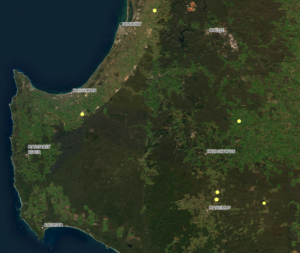
The properties are located near the towns of Boyup Brook, Brunswick, Busselton (Sabina River) and Manjimup (Perup, Wilgarup and Cosy Creek).
Perennial pastures were typically dominated by perennial ryegrass (four of six sites) or cocksfoot (2 sites). Annual pastures were dominated by annual ryegrass, with some weeds such as wild oats present in November and April samples. Sub clover was also present in November but degrading and difficult to sample. Further details on the perennial pastures and sites are described here (Noting that “Busselton Grower 2” was not included in this study).
Results were provided to cattle nutrition consultant Martin Staines who has completed a report as follows.
For more information, see mla-how-do-i-optimise-perennial-grass-management-in-late-spring-and-summer.pdf which includes links to get perennial grasses to thrive and survive, and how to remove excess pasture.
SouthWest NRM’s FEaST Project is supported by the Australian Government through funding from the Natural Heritage Trust under the Climate-Smart Agriculture Program and delivered by South West NRM, a member of the Commonwealth Regional Delivery Partners panel.